


In a move that highlights growing anxiety across India’s livestock sectors, the Poultry Federation of India (PFI), alongside major national animal husbandry alliances, has officially petitioned Prime Minister Narendra Modi’s office. The industry is seeking urgent government intervention to permit the emergency import of 1.5 million metric tons of Genetically Modified (GM) soybean meal to stave off a severe feed supply crunch.
The high-stakes intervention comes as bulk domestic prices for soybean de-oiled cake (soydoc)—the essential protein baseline for livestock, poultry, and aquaculture feed formulations—surged by 25% in a single month, jumping from ₹49/kg ($0.59) in early April to an unsustainable ₹62/kg ($0.74) by mid-May 2026.
Copy of PFI’s Letter to Hon. Prime Minister 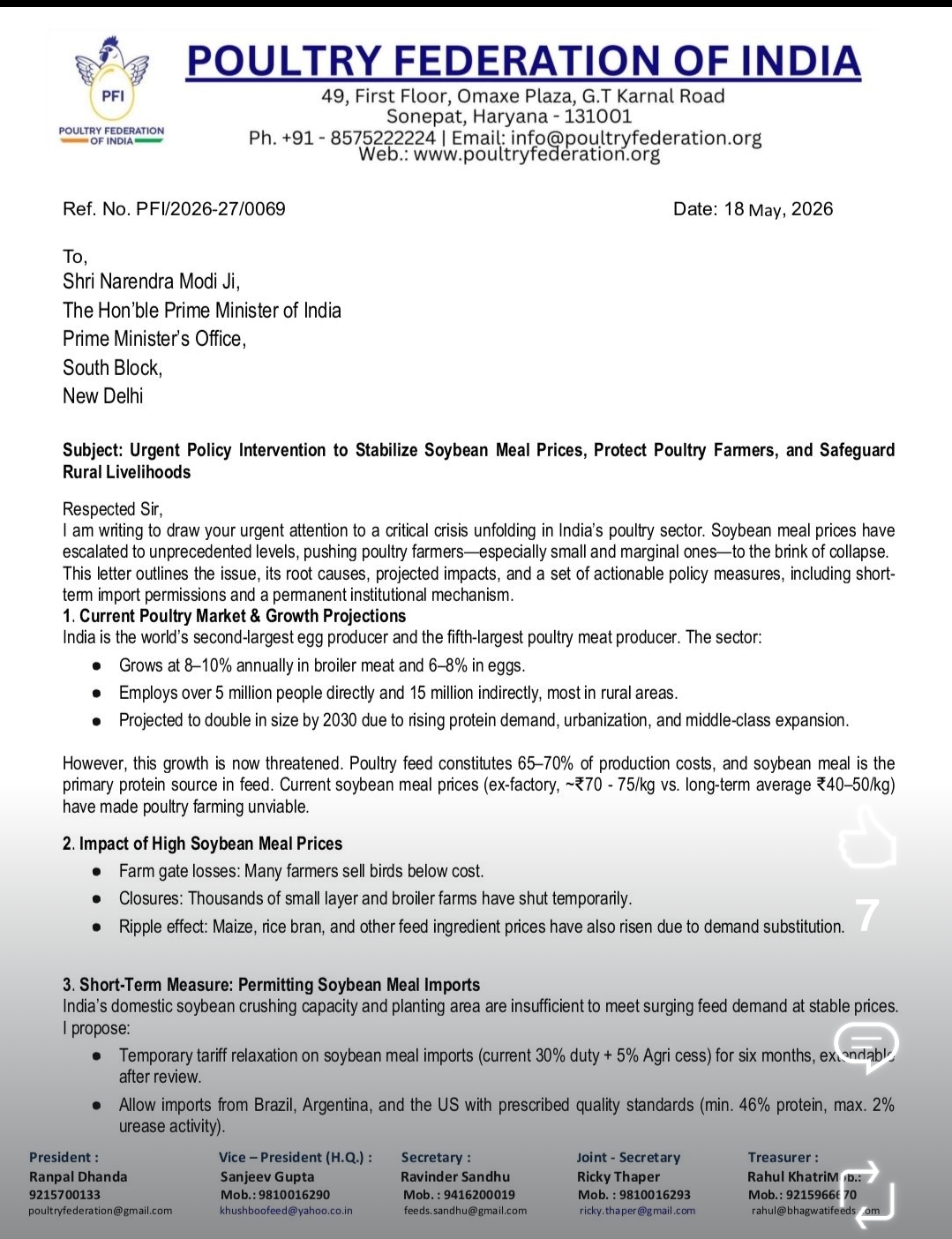
Genesis of the Crisis: A Shrinking Domestic Crop
The ongoing price shock is a direct consequence of a sharp contraction in India’s domestic oilseed harvest during the 2025–26 crop cycle. Data released by the Ministry of Agriculture and Farmers Welfare confirms that national soybean output dropped to 12.72 million tons, a steep decline from the 15.26 million tons harvested in the previous season.
Industry tracking bodies are even more pessimistic. The Soybean Processors Association of India (SOPA) estimates the actual crushable output at just 11.02 million tons, while the USDA’s Foreign Agricultural Service flagged a similar 15% drop. The shortfall is being attributed to a combination of reduced shifting acreage, erratic seasonal monsoons, and farmers diversifying into alternative crops.
Squeezing Farm Profitability
With approximately five months still remaining before the next domestic Kharif crop hits processing plants, feed manufacturers are facing a prolonged supply gap.
-
The Production Math: India requires an estimated 6.0 to 6.6 million tons of soybean meal annually just to sustain domestic livestock operations. With the current crop drop, total domestic soydoc production is projected to slide to 7.8 million tons, leaving virtually no buffer for international commitments or local spikes in demand.
-
Cost Overhead: Because feed costs command 65% to 70% of the total overhead in broiler and egg production, the 25% surge in soydoc has triggered a domino effect. The crisis has simultaneously driven up the prices of secondary feed ingredients like corn and de-oiled rice bran, completely erasing profit margins for small and medium-scale poultry farmers.
PFI’s Strategic Proposal to the Government
To prevent this supply squeeze from turning into a full-blown retail food inflation crisis, PFI Joint Secretary Ricky Thaper outlined a multi-tiered relief plan sent to the Prime Minister’s Office, the Ministry of Commerce, and the Department of Animal Husbandry:
-
The 1.5 Million Ton Import Window: The immediate clearance to import 1.5 million tons of GM soybean meal under strict customs regulations (Chapter 23, HSN Code 23040020/30). Importers would provide legal declarations specifying that the shipments are strictly for animal consumption and entirely barred from entering the human food supply chain.
-
Precedent for Success: The PFI pointed out that the government successfully cleared a similar 1.2-million-ton emergency GM soy import window during a comparable feed supply crunch in 2021, which successfully stabilized local markets without destabilizing long-term dynamics.
-
Extending Speculative Curbs: The poultry sector is also aggressively lobbying for an immediate extension of the trading restrictions on soybean futures at the National Commodity & Derivatives Exchange (NCDEX) to prevent speculative hoarders from artificially inflating prices during the off-season.
Domestic Processors Push Back
The proposal, however, is meeting stiff resistance from domestic oilseed crushers. SOPA has pushed back against the import campaign, arguing that current domestic bean reserves remain mathematically sufficient to meet country-wide demand until the next harvest.
SOPA warned that clearing large-scale, cheap international GM imports would depress local prices, hurting domestic farmers who are already grappling with lower crop yields. Furthermore, processors caution that frequently turning to emergency imports during periods of market volatility could undermine India’s premium, non-GMO status in lucrative export corridors.
Indian Soyabean Meal Stats
Sector Metric |
Current Status (May 2026) |
Direct Structural Impact |
Soya DOC Pricing |
Surged 25% in 30 days (to ₹62/kg) |
Pushing production costs past break-even points for independent farmers. |
Domestic Harvest |
Dropped to 11.02M – 12.72M Tons |
Creates an immediate structural supply deficit of roughly 800,000 tons. |
Import Request |
1.5 Million Tons of GM Soybean Meal |
Designed to bridge the 5-month off-season gap before the new harvest. |
Regulatory Battle |
PFI (Pro-Import) vs. SOPA (Anti-Import) |
Government faces a delicate balancing act between livestock feed security and crop farmers’ margins. |

