


US Poultry Products Market – Macro-Economic Overview
The poultry sector has solidified its position as a primary driver of the U.S. agricultural economy. According to the freshly finalized ‘Poultry – Production and Value 2025 Summary’ issued by the USDA National Agricultural Statistics Service (NASS), the combined total value of U.S. poultry production—encompassing broilers, table eggs, turkeys, and non-broiler chickens—reached an extraordinary $81.7 Billion USD in 2025.
This performance represents a massive 16% year-over-year surge compared to the $70.3 Billion USD recorded in 2024. The data reflects strong domestic consumer demand, optimized corporate slaughter weights, and a highly resilient recovery in egg commodity values following historical supply shocks.
Value Breakdown by Commodity Segment
The $81.7 billion total poultry matrix is highly concentrated, with broilers and eggs commanding a combined 94% of the industry’s entire financial output.
-
Broilers ($44.6 Billion USD / 55% Share): Broiler production remains the undisputed financial heavyweight of the industry, fueled by steady commercial retail demand, competitive processing costs, and a highly integrated corporate system
-
Eggs ($31.5 Billion USD / 39% Share): The table egg sector maintained a powerful valuation footprint. High wholesale pricing structures, steady consumer demand, and a complete restocking of commercial flocks following highly pathogenic avian influenza (HPAI) disruptions drove the sector’s strong financial performance
-
Turkeys ($5.6 Billion USD / 7% Share): Thanks to Thanskgiving – turkey industry represented a decent slice of the value matrix. The sector’s lower market share reflects ongoing structural volume adjustments and shifting consumer buying habits toward year-round broiler alternatives
Regional Dominance
The 2025 summary highlights strong geographic concentration across specific U.S. states, which continue to anchor the nation’s poultry supply chain:
Georgia: The National Broiler Capital
Georgia maintained its position as the undisputed leader in U.S. broiler production, yielding 1.317 billion individual birds over the course of 2025. This output is supported by a massive infrastructure of vertically integrated processing facilities, favorable climate profiles, and a highly efficient logistical network capable of serving both domestic quick-service restaurants (QSR) and global export ports along the Atlantic coast
Iowa: The National Egg Powerhouse
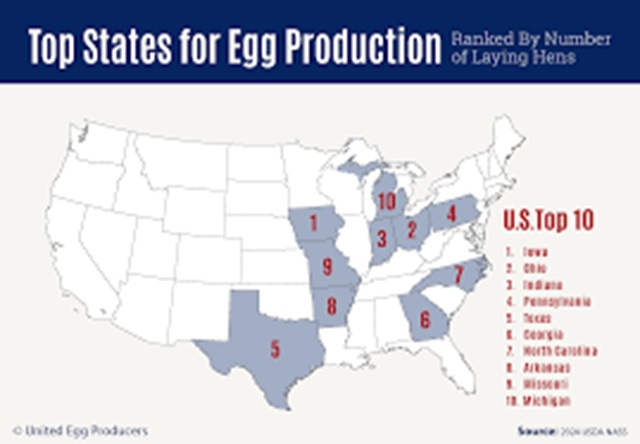
Iowa completely dominated the egg production sector, generating a massive 13.5 billion individual eggs in 2025. This production achieved a total financial valuation of $3.86 Billion USD. Iowa’s dominance stems from its direct access to the nation’s primary corn and soybean belts, allowing mega-flock complexes to minimize feed transport costs and maximize conversion efficiencies at an unmatched industrial scale
Consolidated 2025 NASS Poultry Production Summary
Production Asset Class |
2025 Financial Value |
Percentage Share |
Leading Production Jurisdiction |
Regional Output Volume |
Broiler Chickens |
$44.6 Billion USD |
55% |
Georgia |
1.317 Billion Birds |
Commercial Eggs |
$31.5 Billion USD |
39% |
Iowa |
13.5 Billion Eggs ($3.86B value) |
Turkeys |
$5.6 Billion USD |
7% |
Minnesota / North Carolina |
Standard Structural Distribution |
Combined Totals |
$81.7 Billion USD |
100% |
United States Total |
+16% YoY Value Growth |
Strategic Outlook and Industry Implications
The data from the 2025 summary offers key insights for sector strategy looking ahead:
-
Insulated Cash Flows: The 16% revenue expansion proves that the poultry complex is highly resilient against broader consumer inflation, acting as an affordable, high-demand protein anchor for household budgets
-
Infrastructure Investment Re-investment: The record $81.7 billion valuation is prompting major poultry integrators to increase capital expenditure (CapEx) budgets for 2026. Companies are prioritizing advanced automation in processing plants, AI-driven biosecurity systems, and expanded grain storage to insulate margins from volatile commodity cycles
-
Geographic Clustering: The distinct clustering of production in Georgia and Iowa confirms that access to cheap feed inputs and highly developed processing corridors will continue to dictate the long-term profitability of U.S. protein production

