


This is a strategic overview of the Pet Animals Osteo-Arthritis Treatment Market with evaluation of existing treatment options as well as future products pipeline. Parse the details:
1. Pathophysiology & Clinical Impact
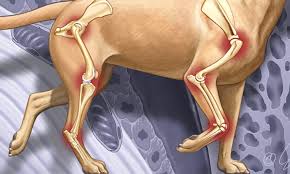
Osteoarthritis (OA), or degenerative joint disease (DJD), is a chronic, progressive, and irreversible inflammatory disorder of diarthrodial joints. It affects approximately 20–40% of the global canine population and up to 60–80% of mature felines. The disease architecture is characterized by:
-
The progressive enzymatic degradation of articular cartilage matrix.
-
Subchondral bone sclerosis and marginal osteophyte production.
-
Chronic, low-grade synovitis driven by the release of pro-inflammatory cytokines
This destructive loop alters joint mechanics, leading to peripheral and central sensitization, manifesting clinically as chronic pain, joint stiffness, and a loss of mobility.
2. Current Therapeutic Treatment Options (Mid-2026)
Modern veterinary medicine relies on a strict multimodal framework to target multiple nodes within the pain and inflammatory cascades.
A. Frontline Pharmacotherapy: NSAIDs & Receptor Antagonists
Non-steroidal anti-inflammatory drugs (NSAIDs) remain a cornerstone for managing pain and inflammation.
-
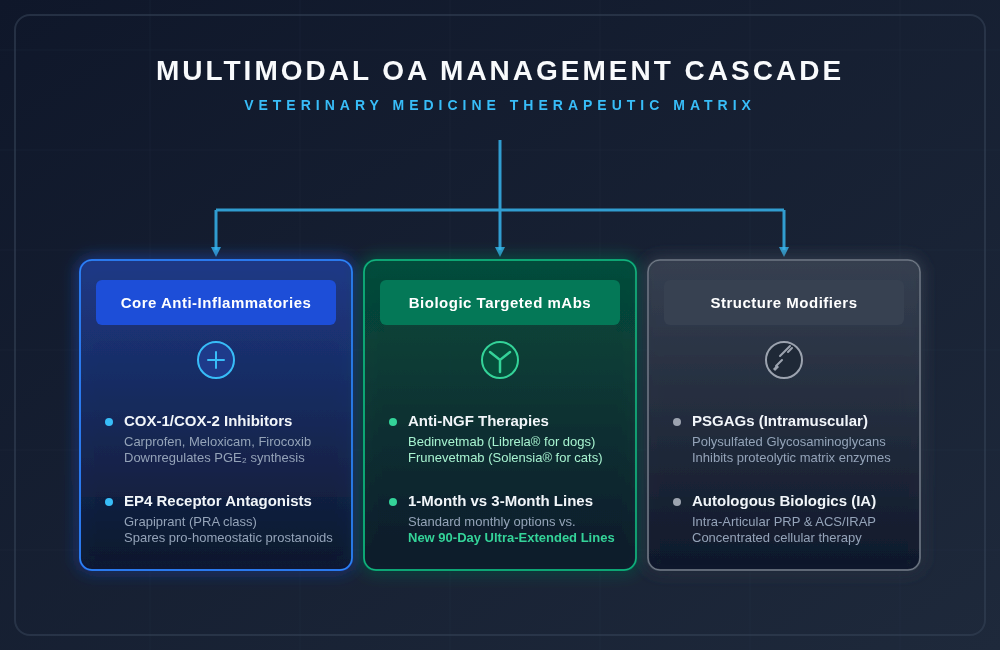
COX-1/COX-2 Competitive Inhibitors: Agents such as Carprofen, Meloxicam, Firocoxib, and Robenacoxib downregulate prostaglandin $PGE_2$ synthesis by inhibiting cyclooxygenase pathways. Long-term usage demands baseline and routine serum biochemistry monitoring to safeguard renal and hepatic perfusion.
-
EP4 Receptor Antagonists (PRA): Grapiprant represents a targeted alternative. By specifically blocking the $PGE_2$ EP4 receptor—the primary mediator of OA-associated pain—it provides anti-inflammatory pain relief while sparing structural pro-homeostatic prostanoid functions, minimizing gastrointestinal and renal adverse risks.
B. Targeted Biologics: The Anti-NGF Revolution
Targeting Nerve Growth Factor (NGF)—a neurotrophin upregulated in osteoarthritic joints that drives both nociceptor sensitization and inflammatory signaling—has changed chronic veterinary pain management.
-
Bedinvetmab (Librela): A fully caninized, once-monthly monoclonal antibody (mAb) that binds to soluble NGF, preventing its attachment to tropomyosin receptor kinase A (TrkA) and p75 neurotrophin receptors.
-
Frunevetmab (Solensia): A fully felinized once-monthly mAb delivering targeted anti-NGF action for cats, bypassing hepatic and renal metabolic clearance routes.
C. Disease-Modifying Osteoarthritis Drugs (DMOADs) & Local Injections
-
Polysulfated Glycosaminoglycans (PSGAGs – Adequan): Administered intramuscularly to inhibit proteolytic enzymes, stimulate proteoglycan synthesis, and preserve existing cartilage integrity.
-
Intra-Articular (IA) Injections: Autologous therapies like Platelet-Rich Plasma (PRP) and Autologous Conditioned Serum (ACS/IRAP) are used locally to supply concentrated anti-inflammatory growth factors directly to the joint environment.
-
Radiosynoviorthesis (Synovetin OA): An intra-articular injection utilizing the conversion of Tin-117m ($^{117\text{m}}\text{Sn}$) into homogeneous conversion electrons. This targeted radiation triggers apoptosis in inflammatory joint macrophages, relieving pain at the source for up to 12 months.
3. Groundbreaking Developments: The Shift to Long-Acting mAbs
The defining regulatory and clinical milestone of mid-2026 is the arrival of long-acting, ultra-extended dosing biologics designed to address chronic compliance challenges.
Izenivetmab (Lenivia® – Zoetis)
Approved by Health Canada, the European Medicines Agency’s CVMP, and recently by the UK’s Veterinary Medicines Directorate (VMD), Izenivetmab marks a major shift in longevity of care:
-
Mechanism of Action: It acts via a novel binding configuration to distinct epitopes on the NGF molecule compared to bedinvetmab.
-
Extended Pharmacokinetics: Delivers sustained pain mitigation and improved functional mobility for three full months (90 days) from a single subcutaneous dose.
-
Clinical Value: Eliminates daily oral dosing and monthly clinical compliance gaps, making it an excellent option for patients where owner compliance or oral administration is a limiting factor.
4. Future Directions & Emerging Translational Pipelines
The next frontier of veterinary joint health is moving beyond symptom management toward true structural regeneration and genetic modulation.
A. Gene Therapy and Transduction Vectors
Research is advancing toward single-injection, long-term intra-articular gene therapies utilizing Adeno-Associated Virus (AAV) vectors. These vectors are engineered to deliver therapeutic genetic code directly to synoviocytes, prompting the continuous production of:
-
Interleukin-1 Receptor Antagonist Protein ($\text{IL-1ra}$)
-
Soluble Tumor Necrosis Factor Receptors ($\text{sTNF-R}$)
By establishing localized, continuous production of these blocking proteins, the joint self-regulates its inflammatory state, potentially pausing structural cartilage breakdown for years.

