


AI-powered identification, precision monitoring and predictive diagnostics are moving from Human Health to the last frontier – livestock management and companion animals healthcare.
After its extensive use case studies in Human Health, Artificial intelligence (AI) is rapidly moving to become a practical tool across the global animal health industry, with new studies and government initiatives demonstrating how machine learning is transforming disease surveillance, livestock traceability, veterinary diagnostics and companion animal care.
Recent developments indicate that AI is increasingly being integrated into veterinary medicine to identify individual animals, monitor health remotely, predict disease outbreaks and support clinical decision-making. Collectively, these innovations are laying the foundation for what industry experts describe as the next phase of “digital veterinary medicine.”
Facial Recognition Replaces Conventional Animal Identification
One of the most promising developments comes from a newly published research study titled “Beyond Humans: Multispecies Animal Face Recognition Using Transfer Learning,” which demonstrates that facial recognition technology can accurately identify multiple animal species without relying on conventional physical identification methods such as ear tags, branding or implanted microchips.
Researchers evaluated deep-learning algorithms across datasets containing dogs, cattle and endangered primates, comparing conventional facial-recognition architectures with modern Vision Transformer (ViT) models. The study reported particularly strong performance in companion animals.
AI Facial Recognition Performance
Species |
Best Verification Accuracy |
Key Application |
|---|---|---|
Dogs |
96.85% |
Pet identification and recovery |
Cattle |
Outperformed previous state-of-the-art systems |
Farm traceability and herd management |
Primates |
Encouraging performance |
Wildlife conservation and biodiversity monitoring |
Unlike RFID tags or implanted microchips, facial recognition provides a completely non-invasive identification method that can be performed remotely using cameras or mobile devices. According to the researchers, this makes the technology attractive for applications ranging from locating lost pets to verifying livestock identity and reducing livestock fraud in commercial production systems.
Applications Extend Across the Entire Animal Health Ecosystem
Industry experts believe AI-based identification systems have applications well beyond simple animal recognition. Potential commercial uses include:
-
Livestock traceability
-
Anti-theft verification
-
Farm biosecurity
-
Automated attendance monitoring
-
Precision breeding
-
Disease surveillance
-
Companion animal identification
-
Wildlife conservation
For commercial dairy and beef operations, AI-powered recognition could allow cameras installed at watering points, feed bunks or milking parlours to automatically identify animals and monitor behavioural changes associated with illness or reduced productivity.
AI Platforms Enter National Veterinary Surveillance
Artificial intelligence is also beginning to support national animal-health surveillance programs.
Saudi Arabia recently unveiled an Artificial Intelligence Animal Health Platform, developed by the Ministry of Environment, Water and Agriculture, to strengthen disease surveillance across livestock populations. The platform integrates veterinary records with real-time field data to monitor disease occurrence, analyse mortality trends and predict outbreak patterns using geographic and temporal analytics.
The system connects with the country’s national livestock database and employs AI models to assist veterinary authorities in identifying emerging health threats earlier than conventional surveillance systems. Officials say the initiative is designed to improve outbreak preparedness while supporting broader food-security and sustainability objectives.
Digital Veterinary Technologies Expand Beyond Diagnostics
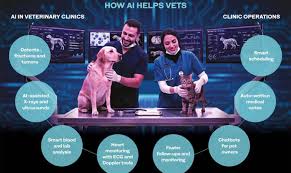
Artificial intelligence is increasingly being deployed throughout veterinary practice, extending well beyond diagnostic imaging.
Research institutions and technology developers are exploring AI-assisted systems capable of:
-
Early disease detection
-
Precision livestock monitoring
-
Clinical decision support
-
Automated image interpretation
-
Behavioural analysis
-
Remote herd surveillance
-
Predictive disease modelling
Machine-learning algorithms are now being trained to analyse data from wearable sensors, thermal cameras, milk-production systems, feeding stations and environmental monitoring devices to identify subtle physiological changes before clinical disease becomes apparent.
Such systems could enable veterinarians and producers to intervene earlier, reducing treatment costs while improving animal welfare and production efficiency.
Veterinary Software Market Enters High-Growth Phase
The rapid adoption of AI is also reshaping veterinary practice management.
According to industry market estimates, the global veterinary software market was valued at approximately US$1.6 billion in 2025 and is projected to reach US$4.3 billion by 2033, representing a compound annual growth rate of 13.3%. Cloud-based platforms account for more than four-fifths of deployments, reflecting the industry’s transition toward integrated digital ecosystems.
Key drivers include:
-
AI-enabled diagnostics
-
Telemedicine integration
-
Cloud-based medical records
-
Automated imaging workflows
-
Data-driven clinical decision support
Precision Livestock Farming Gains Momentum
The convergence of artificial intelligence, computer vision, sensor technologies and cloud computing is accelerating the adoption of precision livestock farming. Modern systems increasingly combine:
-
Facial recognition
-
Weight estimation
-
Gait analysis
-
Feeding behaviour
-
Activity monitoring
-
Environmental sensing
These technologies allow producers to monitor thousands of animals continuously, improving productivity while reducing labour requirements.
Industry analysts believe precision livestock farming will become particularly important as producers face growing pressure to improve sustainability, animal welfare and biosecurity.
Challenges Remain Before Widespread Adoption
Despite rapid technological progress, several barriers continue to limit widespread deployment. These include:
-
Standardisation of datasets
-
Variable image quality in field conditions
-
Integration with existing farm-management systems
-
Cybersecurity and data privacy
-
Infrastructure costs for smaller producers

