The new federal government of Nepal is having its first animal health industry crisis in form of repeat outbreaks of HPAI across major poultry producing areas of Nepal. Economic fallout of these HPAI outbreaks is being felt across larger economy.
The economic fallout from Nepal’s ongoing highly pathogenic H5N1 avian influenza crisis worsened significantly this morning following the publication of a comprehensive nationwide impact evaluation.
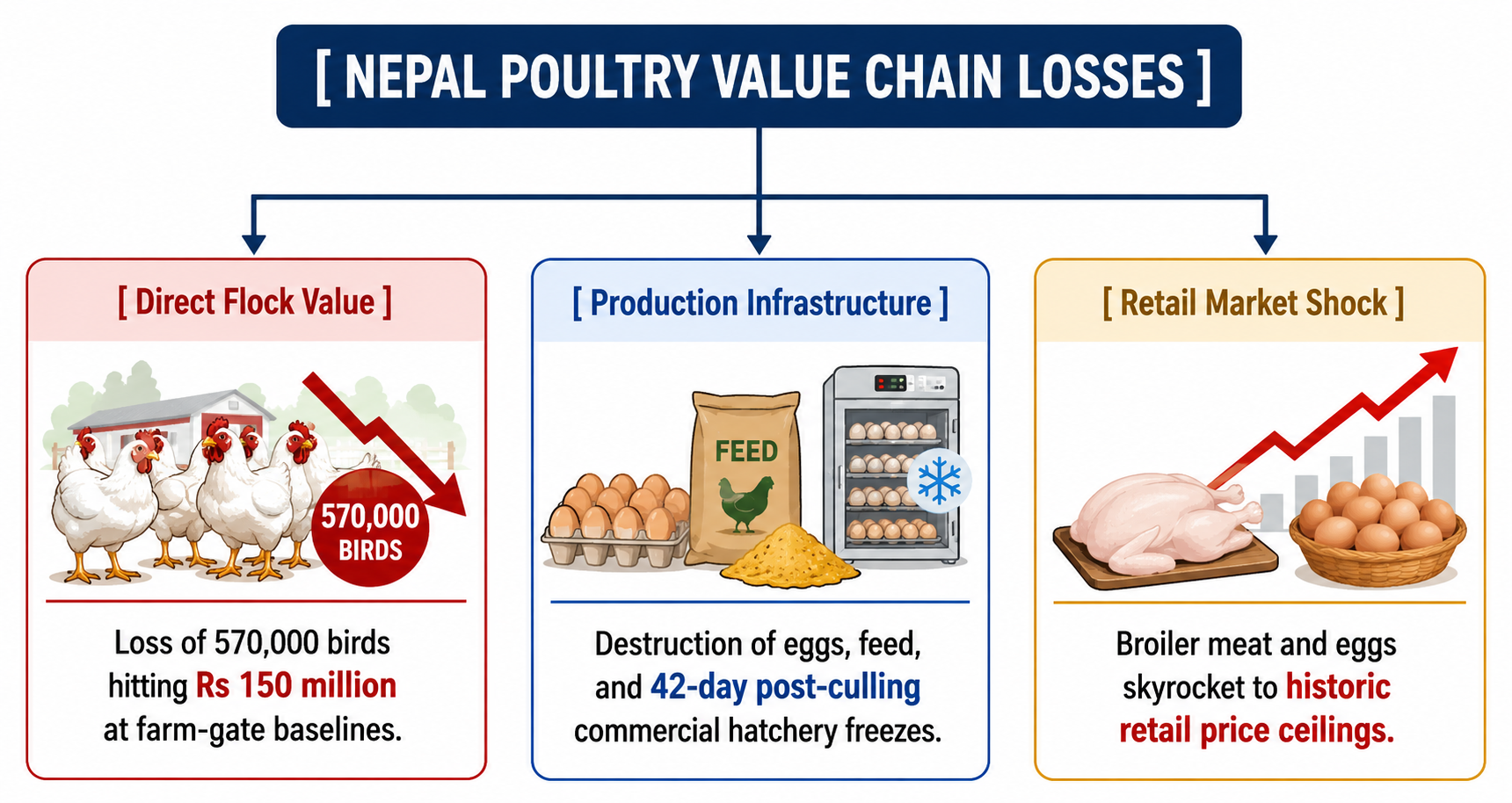
Using multi-layer financial modeling to quantify structural damage across the agricultural value chain, econometricians revealed that the relentless spread of the virus has forced the emergency culling of approximately 570,000 birds. This massive biological liquidation translates to an immediate, non-recoverable loss of up to Rs 150 million in pure farm-gate poultry value alone.
Cumulative Micro- and Macro-Economic Toll
The evaluation notes that calculating the market value of the culled layer hens and broiler flocks only scratches the surface of the industry’s broader financial devastation. When factoring in the mandatory destruction of hundreds of thousands of commercial eggs, contaminated feed reserves, and prolonged hatchery production freezes, the macro-economic damage scales dramatically.
The structural shock is hitting a sector that operates on razor-thin margins:
-
Hatchery Disruption: Because farms hit by confirmed H5N1 strains face immediate, mandatory 42-day operational lockdowns, the local chick supply pipeline has effectively collapsed. Independent farmers are unable to restock their sheds, guaranteeing a prolonged production deficit extending well into the next quarter.
-
Retail Price Spiral: This supply vacuum has triggered a massive shock across urban consumer markets. With key poultry hubs across Koshi Province and the Kathmandu Valley heavily restricted, localized retail prices for broiler meat and table eggs have soared to record highs, straining household food security.