


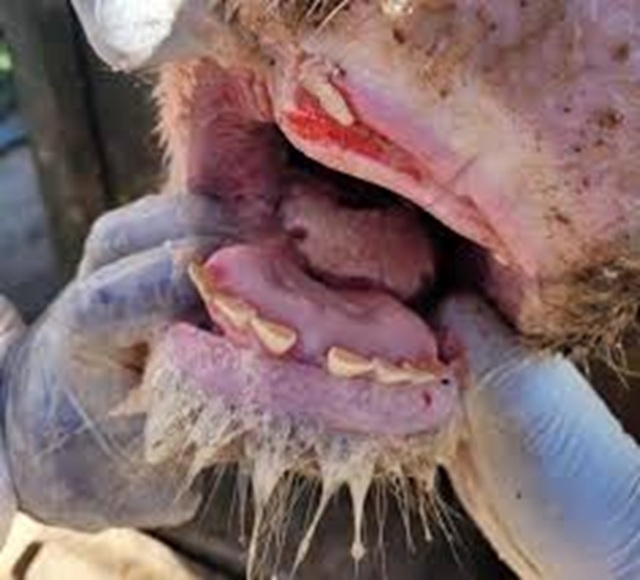
Beijing, China – China’s Ministry of Agriculture and Rural Affairs (MARA) has confirmed a significant change in the country’s animal epidemiology: the first-ever domestic detection of the Southern African Territories Type 1 (SAT1) Foot-and-Mouth Disease (FMD) serotype in China
The virus has potentially affected around 6,229 cattle across two major areass located in the Xinjiang Uyghur Autonomous Region and Gansu Province. Because the locations are separated by more than 2,000 kilometers along China’s northwestern livestock corridor, international animal health bodies—including the UN Food and Agriculture Organization (FAO) and the World Organisation for Animal Health (WOAH)—warn that the virus may have circulated silently before detection.
Immunological Deficit: Zero Cross-Protection
Historically, China’s compulsory national livestock vaccination programs have been built around traditional, locally circulating strains: Serotypes O and A (with the Asia1 serotype undetected since 2009).
Because FMD serotypes do not share cross-immunity, China’s massive national livestock herd is completely immunologically naïve to this African-endemic strain. Current vaccine stockpiles offer zero cross-protection, creating an immediate vulnerability to rapid transmission across commercial beef, dairy, and swine sectors.
High Virulence and Airborne Aerosol Transmission
Epidemiological field data released by veterinary laboratories confirms that the SAT1 strain represents a far more aggressive biosecurity threat than standard Eurasian A and O serotypes:
-
Severe Mortality in Young Stock: While classical FMD strains typically cause high sickness rates but low death rates in adult animals, the SAT1 strain displays extreme virulence in young animals. It causes acute myocarditis (heart muscle inflammation), triggering a mortality rate exceeding 50% in young cattle and calves
-
Airborne Aerosol Spreading: SAT1 possesses highly efficient airborne transmission mechanics. Under favorable temperate spring conditions, the virus can travel long distances via windborne aerosols, allowing it to easily clear standard physical farm boundaries and jump between isolated herds without needing direct animal contact
Regional Breakdown & Transmission Routes
The virus was initially isolated at a livestock market in the Ili Kazakh Prefecture of Xinjiang, located just 85 kilometers from the Kazakhstan border. It was subsequently confirmed on a large holding in Wuwei Prefecture, Gansu Province, roughly 300 kilometers from the Mongolian border.
Both Xinjiang and Gansu serve as high-density pastoral hubs and critical transboundary livestock corridors. Field specialists believe the virus entered the country through informal animal movements or contaminated equipment linking China with Central Asian states, where the SAT1 strain has expanded rapidly since early 2025.
Emergency Containment and Vaccine Scramble
Faced with a threat to its domestic protein supply chain, the Chinese government has activated strict emergency protocols:
-
Stamping-Out & Ring Quarantines: Local authorities in Xinjiang and Gansu have initiated immediate culling, humane destruction, and deep disinfection loops for all infected and susceptible contact animals within the affected zones
-
Inter-Provincial Trade Blocks: Major livestock trading centers—including the North China Livestock Trading Center in Hebei (China’s largest live market)—have placed immediate shipment restrictions on all cloven-hoofed livestock originating from Gansu and Inner Mongolia, trying to shield high-density swine and dairy operations in the east
-
Fast-Tracking Emergency Biologicals: To patch the massive immunity gap, MARA has granted emergency veterinary drug approvals to top domestic laboratories, including Zhongnong Weite Biotech and Jinyu Baoling, to rush SAT1-specific vaccine formulations into mass production within 30 days
China FMD Epidemiological Profile Drift
Parameter Vector |
Historical Baseline (Pre-2026) |
Current Outbreak Profile (May 2026) |
Circulating Serotypes |
Restricted to O and A strains; stable epidemiology. |
SAT1 Incursion (Southern African Territories Type 1). |
Confirmed Geography |
Stable across localized zones (7 outbreaks over 2021–2023). |
Simultaneous detection in Xinjiang & Gansu (>2,000km separation). |
Young Stock Mortality |
Low (<5%); primarily temporary weight loss and milk drops. |
Exceeds 50% in young cattle due to acute viral myocarditis. |
Transmission Vector |
Direct contact, mechanical vectors, fluid shedding. |
High Aerosol Capacity; rapid windborne drift across farm borders. |
Vaccine Protection |
95%+ herd protection via mandatory domestic formulations. |
0% Cross-Protection; total reliance on emergency manufacturing. |

