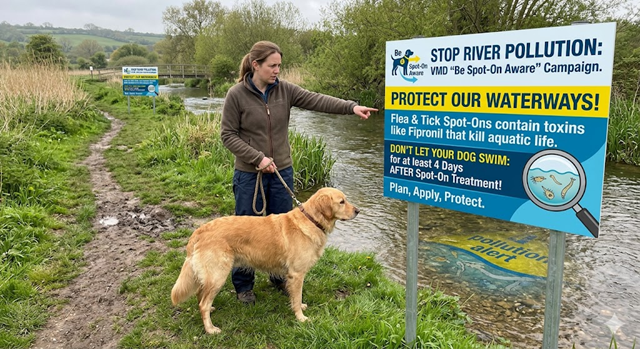
Spot-Ons, once a major innovation and mainstay of companion animals’ parasites management, are now increasingly under threat for potential enviornmental contamination and guidelines are being drawn for their safe usage and disposal post usage.
LONDON, UK — The Veterinary Medicines Directorate (VMD) in Great Britain has officially launched a major environmental and public health awareness campaign titled “Be Spot-On Aware.” The initiative establishes a direct clinical protocol for veterinary professionals to mitigate the downstream environmental effects of common companion animal ectoparasiticides.
The launch comes amid mounting ecotoxicological data showing that highly potent, broad-spectrum chemical compounds used as spot ons in routine pet healthcare are accumulating in inland waterways at levels that pose an immediate threat to aquatic ecosystems.
Ecological Threat: Fipronil and Imidacloprid in British Rivers
Recent environmental monitoring has revealed highly elevated concentrations of fipronil and imidacloprid—two of the most widely used active ingredients in canine and feline flea and tick spot-on formulations—across major UK river systems.
These active ingredients are designed to be neurotoxic to terrestrial parasites, but their high stability means they do not break down easily in water. When washed off a dog’s coat, they enter local aquatic pathways, disrupting or killing non-target aquatic invertebrates, such as mayfly and caddisfly larvae, which form the base of the river food web.
Clinical Protocol: The 3-Step “Plan, Apply, Protect” Framework
To address this pathway, the VMD is calling on all practicing veterinary surgeons and veterinary nurses across Great Britain to deliver a targeted, 3-step script—Plan, Apply, Protect—during every routine flea and tick consultation.
1. PLAN: Smart Pre-Treatment Prep
Veterinarians should instruct clients to plan their pet’s hygiene schedules around their parasite treatments. Any required shampooing, bathing, or heavy grooming must be completed prior to applying the spot-on solution. Bathing a pet shortly after application strips the chemical from the lipid layer of the skin, wasting the treatment and flushing the active toxins directly down household drains into the water system.
2. APPLY: Direct Skin Targeting
Owners frequently misapply spot-on products by pouring the liquid directly onto the animal’s fur. Clinical guidance dictates parting the hair completely at the base of the skull or between the shoulder blades and applying the solution directly and tightly onto the skin layer. Proper application ensures the product is absorbed into the skin’s sebaceous glands, maximizing clinical efficacy and minimizing loose chemical residue on the fur.
3. PROTECT: The 4-Day Water Ban
The most critical environmental directive requires owners to strictly prevent their dogs from swimming in rivers, lakes, streams, or coastal waters for at least 4 days post-treatment. This window allows the compound to fully bind to the skin matrix, preventing the immediate wash-off that drives acute aquatic toxicity.
Regulatory Context and Next Steps
The launch of the “Be Spot-On Aware” campaign coincides with an active regulatory review by the Department for Environment, Food & Rural Affairs (Defra).
Defra’s formal, UK-wide call for scientific evidence exploring the environmental impact of companion animal parasiticides remains open to veterinary behaviorists, ecotoxicologists, and pharmaceutical manufacturers until June 11, 2026.
The data collected during this window will dictate whether the UK government transitions from voluntary veterinary guidelines to stricter legislative restrictions, which could include reclassifying certain over-the-counter spot-on products to POM-V (Prescription Only Medicine – Veterinarian) status to enforce tighter environmental oversight.
AHI Opinion
Pet parents and practicing veterinarians have “ecologically” better options in form of oral, chewable, newer parasiticides in form of Isoxazoline compounds, popular as Afloxalaner, Sarolaner, Fluralaner and Lotilaner. These products are available only as oral tablets and not as spot-ons and hence can be used as effective alternatives for “spot-ons”.