


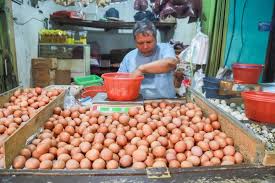
BLITAR, INDONESIA — The courtyard of the Blitar Regency Government Office in East Java turned into a scene of mass scramble and public uproar. Hundreds of small- and medium-scale layer poultry farmers from across the region—including Blitar, Tulungagung, Kediri, Trenggalek, and Malang—staged a dramatic peaceful demonstration.
To draw desperate attention from the central government to a prolonged, severe price slump, the farmers distributed 1 million free eggs, equivalent to approximately 62.5 tons, directly to thousands of pushing and shoving residents.
Micro-Data Behind the Financial Deficit
The grassroots giveaway was executed as a calculated act of economic protest against farm-gate egg values plunging far below the Cost of Production (COP). According to protest coordinator Suyanto, the severe margin squeeze has persisted for nearly three months with no structural relief in sight.
Currently, farm-gate egg prices have fallen to IDR 20,000 – IDR 21,000 per kilogram, while the absolute bare-minimum cost to produce those eggs stands at IDR 23,000 per kilogram. This creates an immediate loss of IDR 2,000 for every single kilogram of eggs sold by independent smallholders.
Compounding the problem, the National Food Agency (Bapanas) and the central government had previously established an official benchmark reference sales price (HAP) ranging from IDR 24,500 to IDR 26,500 per kilogram. Farmers note that while these protections exist on paper, a total lack of regulatory enforcement in the field has left them entirely at the mercy of a crashing open market.
Feed Hikes and the Import Monopoly Burden
While egg prices have tanked, the cost of commercial livestock feed has simultaneously skyrocketed by roughly 30% to 100%.
Farmer representative Suryono noted that because more than 35% of essential poultry feed ingredients are imported commodities, local mill feed costs are highly sensitive to the sharp depreciation of the Indonesian Rupiah against the U.S. dollar.
Furthermore, farmers laid direct blame on state-owned enterprise Berdikari, pointing to its single-gate monopoly over imported feed materials. Farmers argue this lack of import competition forces independent operations to buy raw feed components at non-competitive rates, saddling producers with an additional artificial cost burden of roughly IDR 2,000 per kilogram.
Rejecting Foreign Investors and Demanding SPHP Corn Relief
Beyond short-term price interventions, the protesting coalitions used the platform to issue a stern policy warning to the central government regarding the structural future of Indonesian agriculture. Smallholders expressed strong opposition to ongoing legislative discussions aimed at allowing large-scale foreign investors into Indonesia’s domestic livestock sector. The agricultural unions warned that opening the doors to foreign mega-corporations would trigger aggressive, hyper-industrialized local competition, effectively wiping out small- and medium-sized family farms.
The farmers are demanding immediate government action on two fronts:
-
Direct market interventions to stabilize farm-gate egg prices back into a livable range of IDR 24,000–25,000 per kilogram.
-
Substantial price reductions and increased subsidies for SPHP (Stabilization of Food Supply and Prices) feed corn.

