


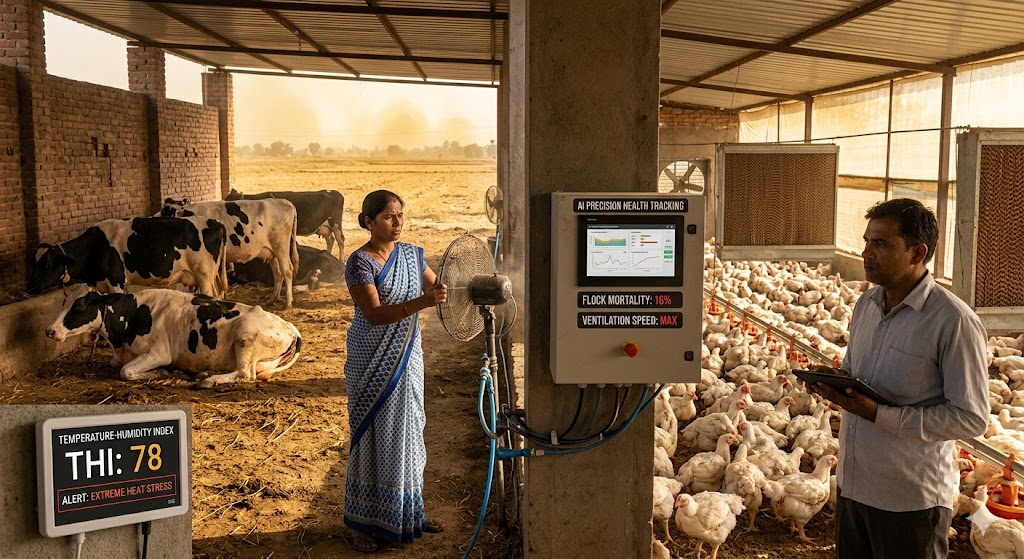
India imports more than 80% of its fuel requirements and as disruptions in supply chains due to Iran war wrek India’s so far resilient economy – trouble is brewing in India’s largest sector by emplyment, Agriculture, not by Iran war heat but by envrionmental heat in form of rising temperatures continued heatwaves across large swates of the country.
Prolonged, intense summer heatwaves pushing ambient temperatures consistently above 45°C across central, northwest, and southern India have placed the country’s high-growth allied agricultural sectors such as Dairy and Poultry industry under unprecedented operational stress and losses to animal farmers.
Data released by veterinary authorities and corporate agribusinesses reveals that extreme heat stress has breached the critical biological thresholds of livestock, triggering spiked poultry mortality, contracting milk yields, and threatening the financial stability of the rural economy.
Because the livestock sector contributes 30.23% to agricultural Gross Value Added (GVA) and serves as a vital source of daily cash flow for smallholders, the ongoing crisis is rapidly transitioning from a seasonal hazard into a major macroeconomic challenge.
Dairy Crisis: Milk Yield Contractions & The THI Breach
The dairy sector—where India leads global production, accounting for nearly 25% of global output—is highly exposed to climatic shocks. Commercial dairy farms across, report that milk yields have dropped between 5% and 12% during peak heat periods, with severe drops approaching 20% among high-yielding crossbred cows (such as Holstein-Friesian and Jersey variants) if active cooling mechanisms fail.
Temperature-Humidity Index
The clinical breakdown in milk synthesis is governed by the Temperature-Humidity Index (THI). Dairy cattle enter a state of metabolic stress the moment the THI breaches a threshold baseline of 72.
To survive the thermal load, cattle pivot away from milk production to focus on thermoregulation, causing a heavy drop in feed intake. This self-induced anorexia creates a severe systemic energy deficit, immediately suppressing milk yield, altering fat-to-protein ratios, and escalating susceptibility to secondary bacterial mastitis.
Poultry Shock: Mortality Spikes Past 15% Baseline
The impact of the heatwave is even more severe across commercial broiler and layer operations, where extreme temperatures are triggering high cardiovascular and respiratory failure.
-
Spiked Mortality: Historical summer mortality rates for commercial broilers traditionally hover between 8% and 10% (inclusive of transportation losses). Field data from major production hubs across Andhra Pradesh’s NTR, Eluru, and Krishna districts confirm that mortality has surged past 15% in poorly ventilated, open-sided operations
-
Physiological Breakdown: Lacking sweat glands, birds rely entirely on evaporative cooling via panting (hyperventilation). Prolonged heat exposure causes excessive expelling of carbon dioxide (CO2), shifting blood pH levels and inducing severe respiratory alkalosis. This biochemical imbalance culminates in acute cardiovascular collapse
-
Production Drop: Surviving birds exhibit stunted body weight accumulation due to heat-induced lethargy. Concurrently, layer operations are tracking a sharp drop in overall egg production and diminished egg size metrics, driven by a heat-linked disruption in calcium carbonate transfer
Financial Impacts & Macro-Economic Ripple Effects
The economic damage from this ongoing thermal event extends far beyond localized production losses, introducing systemic financial risks to rural credit markets, banking institutions, and consumer price indices.
Microfinance and Banking Risk
According to banking research briefs, the contraction in livestock productivity is weakening the repayment capacity of lower-income rural borrowers. For small and marginal farmers who rely on routine milk and poultry sales to smooth out seasonal crop income fluctuations, a 12% drop in daily yields directly hits fluid cash flow.
Financial analysts warn that inadequate heat adaptation could place a substantial share of rural and microfinance loan portfolios under stress, contributing to a broader climate-driven drag of 2.5% to 4.5% on India’s annual GDP by 2030.
Inflationary Pressures on Consumers
To offset rising production outlays—such as elevated electricity tariffs from running continuous cooling systems and soaring green fodder premiums—large-scale dairy cooperatives (including Amul and Mother Dairy) are facing intense margin compression. This structural inflation is mirroring prior pricing cycles where retail milk prices were forced upward by an average of ₹2 per litre to absorb climate-induced supply shocks.
Sector |
Immediate Material Impact |
Secondary Financial Outcome |
Dairy Production |
5% to 12% drop in daily milk yields; increased incidence of clinical mastitis. |
Reduced daily cash flow for smallholders; upward pressure on consumer retail prices. |
Poultry Operations |
Mortality rates surging past 15%; stunted broiler growth and diminished egg sizes. |
Supply chain contractions; projected monsoon shortages of chicken and eggs. |
Rural Banking & BFSI |
Weakened daily/weekly wage realization among marginal livestock handlers. |
Rising collection stress in microfinance and unsecured rural loan portfolios. |
Emergency Interventions and Response by State
To stem immediate losses, State Animal Husbandry Departments and veterinary task forces have deployed mobile units to guide producers through emergency climate-mitigation protocols:
Immediate Farmgate Upgrades
-
Evaporative and Structural Cooling: Integrators are mandated to run overhead roof-cooling sprinklers, set up low-pressure misting fans, and apply reflective solar-coatings to shed ceilings to drop internal temperatures by a vital 3°C to 5°C
-
Chrono-Feeding Adjustments: Poultry and dairy managers are instructed to halt feed distribution during peak daylight hours (10:00 AM to 4:00 PM) to minimize the internal metabolic heat generated by digestion. Feeding is being shifted entirely into cooler early morning and late evening brackets
-
Nutritional Therapy: Water lines are being heavily fortified with oral rehydration salts (ORS), automated electrolyte solutions, B-Complex vitamins, and Vitamin C to stabilize cellular membranes and combat respiratory alkalosis
As heatwaves become more frequent and prolonged, the consensus among agricultural economists is that temporary emergency advisories are no longer sufficient.
While the Union Budget 2026–27 expanded allocations to the Department of Animal Husbandry & Dairying to ₹6,153.46 crore (a 16% increase), future policy must focus heavily on funding the structural conversion of traditional farms into Environmentally Controlled (EC) sheds. Additionally, scaling up digital monitoring public infrastructure—such as the Bharat Pashudhan Portal and AI-driven precision livestock platforms—will be critical to transition the country’s rural economy from reactive disaster response to predictive, climate-resilient asset protection.

