


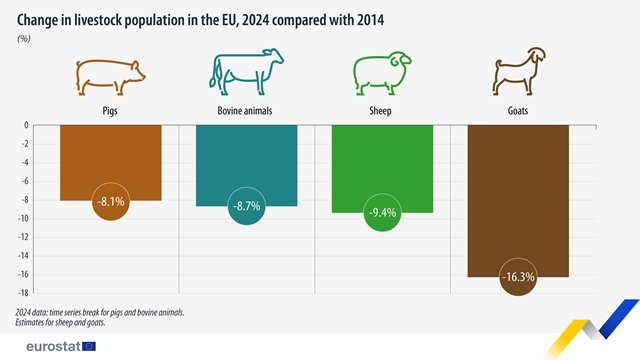
BRUSSELS, BELGIUM — The European livestock sector is facing a profound structural contraction. According to compiled livestock census figures, regional carcass registries, and the latest semi-annual agricultural data, the European Union cattle herd and overall calf crop are projected to shrink even further through the remainder of 2026.
This domestic supply deficit, paired with the strict enforcement of new environmental and import compliance frameworks, has triggered a sharp increase in wholesale and retail beef prices across Central Europe. As a result, price-sensitive consumers are pulling back, forcing a notable decline in domestic beef consumption and altering the continent’s protein landscape.
Numbers Behind the Shrinking Herd
The decline in the EU’s bovine inventory is not a temporary market swing, but the result of multi-year structural changes. Total cattle numbers across major producing nations—including France, Germany, and Poland—have dropped by an estimated 1.8% to 2.4% year-over-year. Key Drivers of the Deficit:
-
The Dairy-Beef Decoupling: Decades of dairy herd optimization mean fewer, more efficient cows are required to meet EU milk quotas. Because the dairy sector traditionally supplies over 50% of the calves destined for beef fattening, the shrinking dairy herd has directly reduced the baseline calf crop
-
Input Cost Fatigue: While feed prices have normalized from their 2022–2023 peaks, prolonged high energy costs, strict animal welfare regulations, and expensive credit have discouraged independent farmers from rebuilding their breeding stock
-
Inter-Generational Shift: A lack of generational renewal is forcing older European cattle ranchers into retirement, leading to permanent farm liquidations rather than ownership transitions
Regulatory Bottlenecks: Tight Import Rules Limit External Supply
In normal market cycles, a domestic production deficit is quickly balanced by an increase in foreign imports. However, Europe’s strict regulatory framework has effectively blocked alternative supply chains from stepping in:
-
Deforestation Regulation (EUDR): The implementation of strict geolocation and anti-deforestation tracing mandates has created major compliance bottlenecks for traditional South American suppliers, limiting incoming volumes from Brazil and Argentina
-
UK Trade Disconnection: Continued administrative friction and new health certificate requirements at border control posts have slowed down the transit of premium Irish and British beef cuts moving into mainland Europe
-
Antimicrobial Mirror Clauses: The impending enforcement of strict new reciprocity rules on antimicrobial use means foreign producers must prove their livestock were raised entirely without growth promoters or specific human-reserved antibiotics, excluding a massive pool of global suppliers
Retail Price Surges & Central European Consumption Slump
With domestic slaughterhouses operating at lower capacities and international supply restricted, wholesale beef prices have hit record highs. This price pressure has passed directly down the supply chain to retail supermarkets and foodservice networks across Central Europe (including Germany, Austria, Switzerland, and the Czech Republic).
By mid-2026, average retail prices for premium beef cuts across Central European supermarkets surged by 14.6% year-over-year, while processed ground beef options increased by 9.2%.
Consumer Response
Confronted by persistent living cost pressures, European households are pushing back against high beef prices. Total domestic beef consumption in Central Europe is projected to drop by 6.2% over the full calendar year.
In response, major supermarket chains like Aldi Nord and REWE have reported a clear structural pivot: consumers are aggressively downsizing their beef purchases in favor of more affordable white proteins, leading to record-high volumes for the domestic poultry sector.
Mid-Term Market Outlook
Market analysts project that the European cattle deficit will persist through 2027. Because rebuilding a beef cow herd requires a minimum three-year biological cycle (from breeding to slaughter-ready weight), supply lines cannot recover quickly.
Faced with permanent structural reductions, major European meat processors are diversifying their business models. Many are investing directly in value-added hybrid protein products, plant-based alternatives, and integrated poultry operations to protect their corporate margins from the ongoing decline of the European cattle industry.
Data & Source Attributions: Eurostat Livestock Census Briefings; European Commission Directorate-General for Agriculture and Rural Development (DG AGRI) Short-Term Outlooks; USDA Foreign Agricultural Service (FAS) European Market Dispatches (May 2026).

