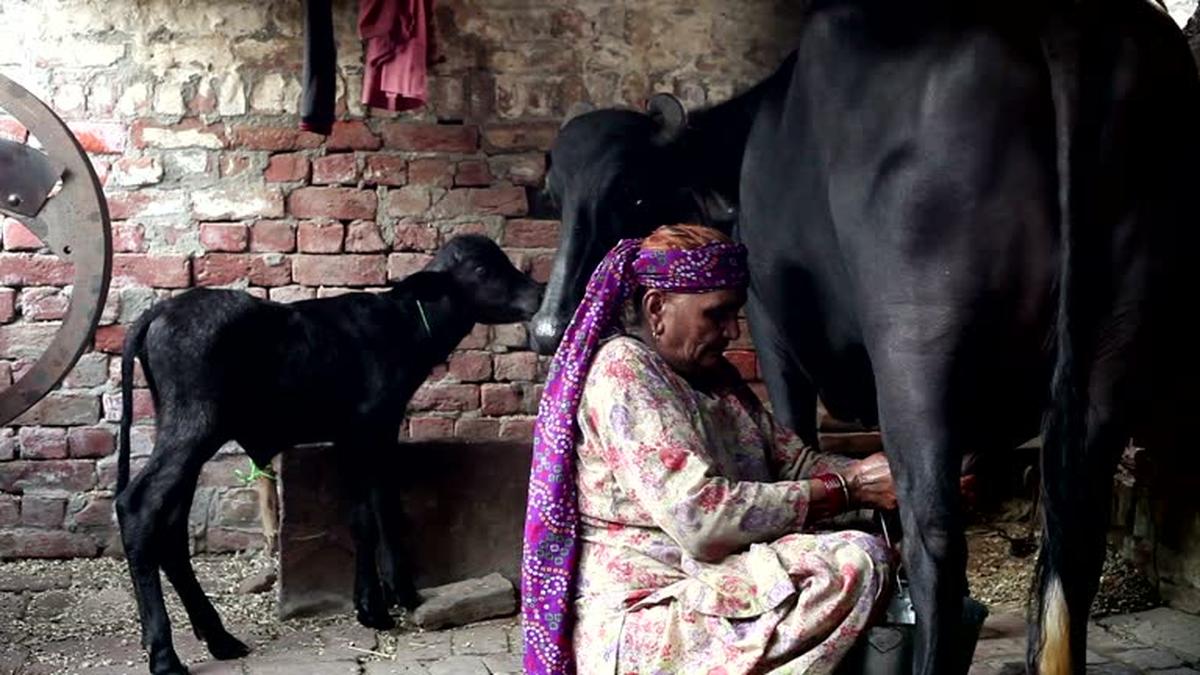


Commercial dairy farms have known for long and have experienced, first hand, the impact of climatic changes on the daily milk production in lactating animals. This gets reaffirmed and quantified with a new, landmark study.
In a landmark, decade-long environmental-livestock study published in the peer-reviewed journal Scientific Reports, scientists have established a definitive causal link between accelerating global warming anomalies across the trans-Gangetic plains and a significant reduction in India’s bovine milk production capacity.
The extensive panel-data analysis reveals that unprecedented climatic variability is acutely undermining livestock productivity across the Global South. The most pronounced vulnerabilities are now documented within the high-milk-producing tracts of Haryana—traditionally the bedrock of India’s premium dairy supply chain.
Vulnerability: Overheating the Trans-Gangetic Plains
The multi-year study monitored complete livestock populations across 1,148 surveyed villages, capturing real-time physiological and production data from millions of animals, including 4.66 million cross-bred cattle, 2.86 million indigenous cattle, and 35.56 million buffaloes.
The findings prove that when ambient surface temperatures exceed 38°C in tandem with relative humidity crossing 70%—a scenario increasingly common during the peak summer and monsoon months of July and August—bovine metabolic synthesis drastically breaks down.
Extreme heat stress triggers an immediate increase in internal cortisol levels, which interferes with endocrine pathways, disrupts systemic energy metabolism, and directly blocks milk ejection. Conversely, ambient winter temperatures were documented to have a negligible effect on overall multi-species production metrics.
Biological Drain: Why Buffaloes Bear the Brunt
While cross-bred cattle demonstrated sharp productivity declines during prolonged heatwaves, indigenous cattle breeds (such as Sahiwal and Hariana) maintained stable baselines due to evolutionary adaptations like efficient sweating mechanics and lower metabolic heat production. Buffaloes, however, face a severe biological disadvantage.
Because of their dark hide, bare skin, and a pronounced deficiency in functional sweat glands compared to cattle, buffaloes struggle to shed excess heat via evaporative cooling. Consequently, the study verified a highly disruptive mathematical correlation: a single unit increase in Potential Evapotranspiration (PET) (mm/day) directly strips roughly 1.4 litres of milk per buffalo, per day.