

HomeSwineIndia’s First Scientific Pig Housing Model Deployed in Rishikesh to Combat African...

India’s First Scientific Pig Housing Model Deployed in Rishikesh to Combat African Swine Fever

In a major structural intervention for India’s animal husbandry sector, the Department of Animal Husbandry, Government of Uttarakhand, in collaboration with the People for Animals–Public Policy Foundation (PFA-PPF), has inaugurated the nation’s first Scientific Pig Housing Model Demonstration Unit.

Unveiled at the Livestock Extension Officer Training Centre in Pashulok, Rishikesh, by Dr. Udai Shankar, Director of the state’s Animal Husbandry Department, the pioneering installation establishes a high-welfare blueprint for commercial pig farming. Designed as a life-sized, walk-through educational installation, the unit enables livestock owners, agricultural entrepreneurs, and state veterinary officers to study advanced, bio-secure housing layouts via models, architectural blueprints, and interactive displays without the use of live animals.

The facility arrives as a direct defense infrastructure update against African Swine Fever (ASF)—a highly contagious, panzootic viral disease causing up to 100% mortality in domestic herds, which has systematically devastated the livelihoods of pig farmers across northern and northeastern India.
download 4 4

Structural Biosecurity: Breaking the 100% Mortality Wave

Under India’s National Action Plan for the Prevention, Control, and Containment of African Swine Fever, the confirmation of a single ASF positive case forces veterinary teams to enforce immediate, non-negotiable culling of all swine within a 1-kilometer infected zone. Past epizootic waves across North India have led to the destruction of tens of thousands of animals, wiping out regional breeding colonies.

Because ASF lacks an approved commercial vaccine or treatment, farm-gate architectural biosecurity acts as the only viable defense line. The Rishikesh Demonstration Unit bridges a major scientific gap by shifting animals out of unhygienic, high-stress concrete pens into specialized, environment-controlled configurations.

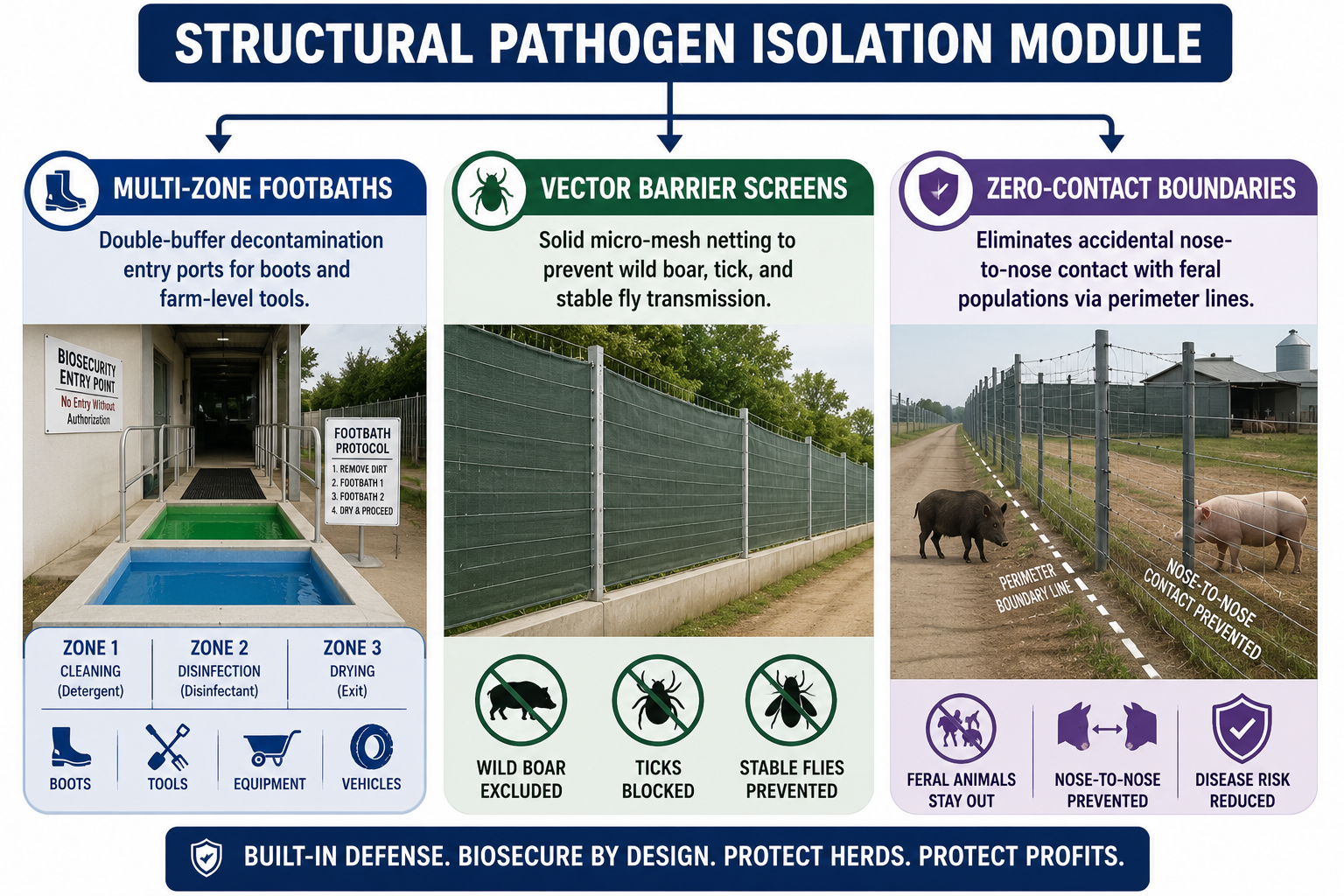
The facility demonstrates how basic structural upgrades intercept transmission pathways:

  • Vector Interception: The layout integrates heavy perimeter fencing and micro-mesh vector screens to prevent stable flies, ticks, and free-roaming wild boars—the primary natural reservoirs of the ASF virus—from interacting with the domestic herd.

  • Decontamination Buffer Zones: The blueprint mandates a single-entry pipeline featuring automated footbaths and equipment-wash stations, neutralizing potential vehicular or footwear tracking before humans step into the production space.

  • 6cf835a0 0b8a 4abb afd2 ea37a69fd6c7

Immunology of Welfare: Group Housing & Crate-Free Farrowing

Historically, commercial swine production in India has relied on restrictive gestation crates and tight tethering. The Rishikesh model rejects this infrastructure, demonstrating that animal welfare is directly linked to immune resilience. Hormonal testing in overcrowded, high-consequence facilities reveals elevated cortisol spikes, which suppress the swine immune system and leave herds vulnerable to viral infiltration. The walk-through facility showcases two fundamental design corrections:

I. Crate-Free Farrowing & Nesting Suites

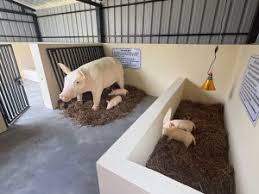
Traditional farrowing crates lock a mother pig in a narrow metal frame to prevent her from accidentally crushing her piglets. The Rishikesh model utilizes open, crate-free farrowing pens that grant the sow complete freedom of movement to build natural nests.

To safeguard the litter, the layout integrates a specialized heated creep area—a protected micro-climate zone equipped with thermal lamps that naturally attracts piglets away from the sow’s resting space when she is moving.II. Group Housing & Deep-Litter Matrix

Instead of isolating adult pigs in individual concrete slots, the unit showcases social group housing parameters. The floor design utilizes an organic deep-litter bedding matrix (composed of straw and sawdust), allowing the animals to express natural rooting behaviors. This bedding dynamically absorbs moisture, reduces ammonia gas buildup, and prevents debilitating hoof lesions, while naturally preserving herd energy and structural vitality.

Scalable Extension & Regional Training Integration

“The welfare of an animal begins with the space we provide it to live,” stated Gauri Maulekhi, Trustee and Member Secretary of the PFA-Public Policy Foundation. “Animal housing is not simply an infrastructure issue—it is the foundation of animal health and welfare. We hope this Demonstration Unit becomes a model that transforms pig housing across India.”

Moving forward, the Rishikesh unit will function as a permanent capacity-building repository for the state of Uttarakhand. The Animal Husbandry Department will integrate mandatory walk-throughs of this facility into its continuing veterinary education (CVE) courses for field officers and state-sponsored training programs for progressive livestock farmers. By making scientific, high-welfare blueprints accessible to rural communities, the initiative aims to shift the Indian swine industry toward sustainable, disease-resistant production.

Animal Health India Editorial Team
Animal Health India Editorial Teamhttps://animalhealthindia.com
Animal Health India (AHI) is an independent news and intelligence platform covering the global animal health, veterinary, livestock, poultry, companion animal and pet food sectors. Our editorial team comprises veterinary journalists, animal health professionals, regulatory affairs specialists and industry analysts with over 30 years of combined experience covering India, Asia, Europe and North America. AHI publishes news, regulatory updates, market intelligence and company news drawn from primary sources including DAHD, EMA, USDA, AVMA and leading veterinary publications worldwide.
RELATED ARTICLES