



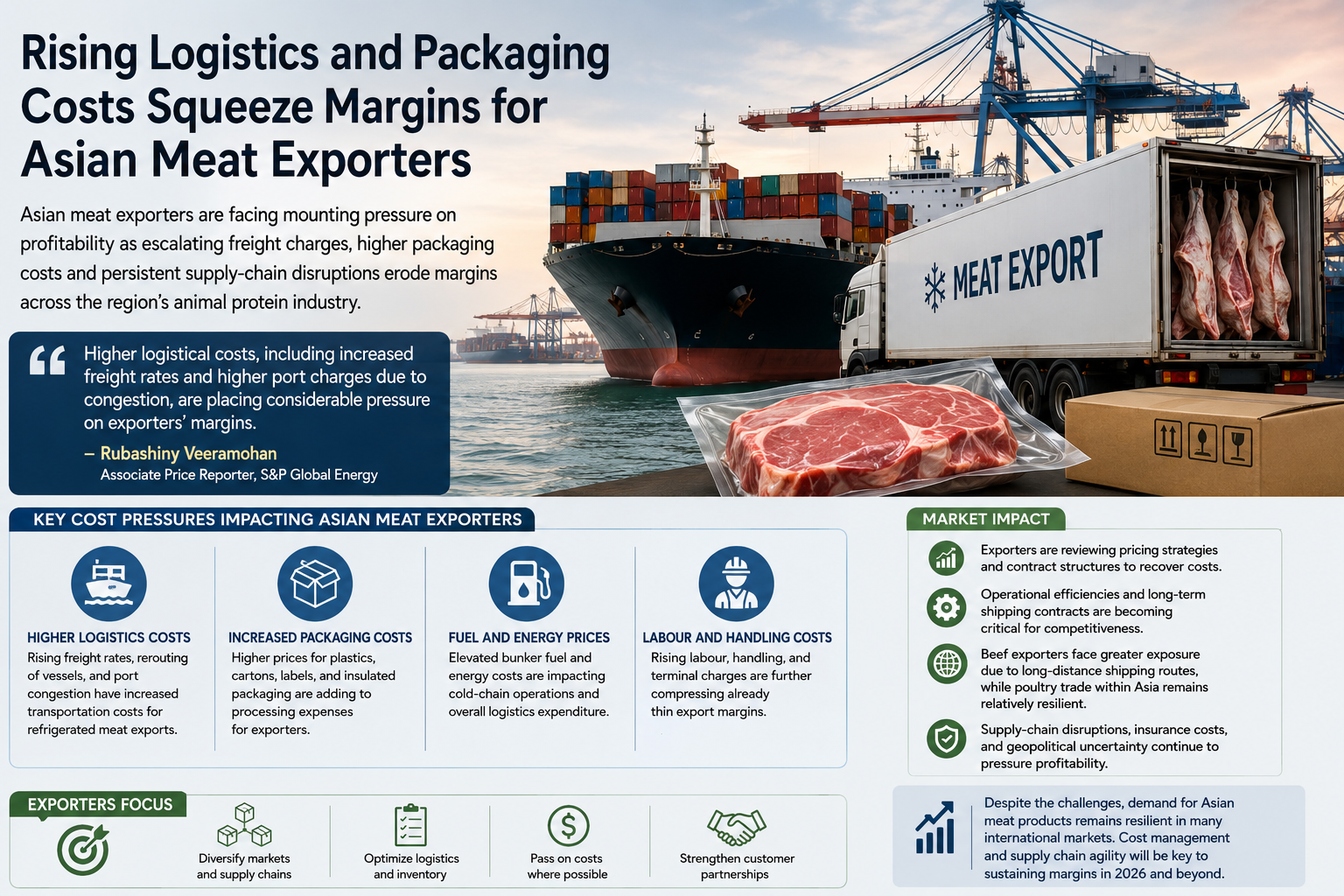
Asian meat exporters are facing mounting pressure on profitability as escalating freight charges, higher packaging costs and persistent supply-chain disruptions erode margins across the region’s animal protein industry, according to market analysts. The end of Iran war hostilities was supposed to bring sanity to the markets but its effects on reduction in freight rates is yet to be seen.
Speaking to Asian Agribiz, Rubashiny Veeramohan, Associate Price Reporter at S&P Global Commodity Insights (Energy), said that exporters are increasingly struggling to absorb higher operating costs as geopolitical tensions and logistical bottlenecks continue to reshape global trade flows.
“Higher logistical costs, including increased freight rates and higher port charges resulting from congestion, are placing considerable pressure on exporters’ margins,” Veeramohan noted.
Freight Inflation Hits Export Competitiveness
Shipping costs have emerged as one of the largest variables affecting meat exporters across Asia in 2026. Ongoing disruptions to international maritime routes, vessel rerouting, port congestion and elevated fuel prices have increased transportation costs for refrigerated cargo moving between Asia, the Middle East and Europe.
The impact is particularly significant for chilled and frozen meat exports, where refrigerated container availability, transit reliability and energy-intensive cold-chain logistics are critical to maintaining product quality.
Industry participants report that higher bunker fuel prices and longer sailing routes have increased overall logistics expenditure, reducing export profitability even where international meat prices have remained relatively firm.
Packaging Costs Punch a Hole in Profitability
In addition to transportation expenses, exporters are contending with rising prices for packaging materials, including plastics, cartons, labels and insulated packaging required for international meat shipments.
Energy-intensive packaging manufacturing, higher raw material prices and increased labour costs have combined to raise overall processing expenses, adding another layer of pressure on already narrow operating margins.
Processors are increasingly seeking efficiencies through lightweight packaging, automation and procurement optimisation, although these measures have only partially offset higher input costs.
Beef Exporters Face the Greatest Exposure
Among the various protein sectors, beef exporters appear particularly vulnerable because of their greater dependence on long-distance international shipping.
Recent market analysis indicates that Australian beef exports have experienced shipment disruptions and rerouting challenges as changing maritime conditions affect traditional trade corridors. Exporters have had to adapt logistics strategies while maintaining delivery schedules to key Asian markets.
By contrast, poultry exports within Asia have generally been less affected due to shorter regional supply chains, although processors continue to monitor freight and packaging costs closely.
Asian Producers Focus on Cost Recoveries
The sustained increase in logistics costs is prompting exporters to review pricing strategies, contract structures and market priorities.
Some producers are attempting to pass higher costs through to overseas buyers where market conditions permit, while others are focusing on operational efficiencies to preserve competitiveness.
Industry analysts note that exporters with integrated processing operations, diversified export destinations and long-term shipping contracts are generally better positioned to withstand cost volatility than smaller independent processors.
Supply Chains Under Continued Pressure
The latest market commentary reflects a broader structural shift affecting the global animal protein industry. Beyond freight inflation, exporters continue to navigate:
-
port congestion and longer vessel turnaround times;
-
higher insurance costs linked to geopolitical uncertainty;
-
volatility in marine fuel prices;
-
increased energy costs for refrigerated storage and transportation; and
-
elevated labour and handling expenses across major export terminals.

