


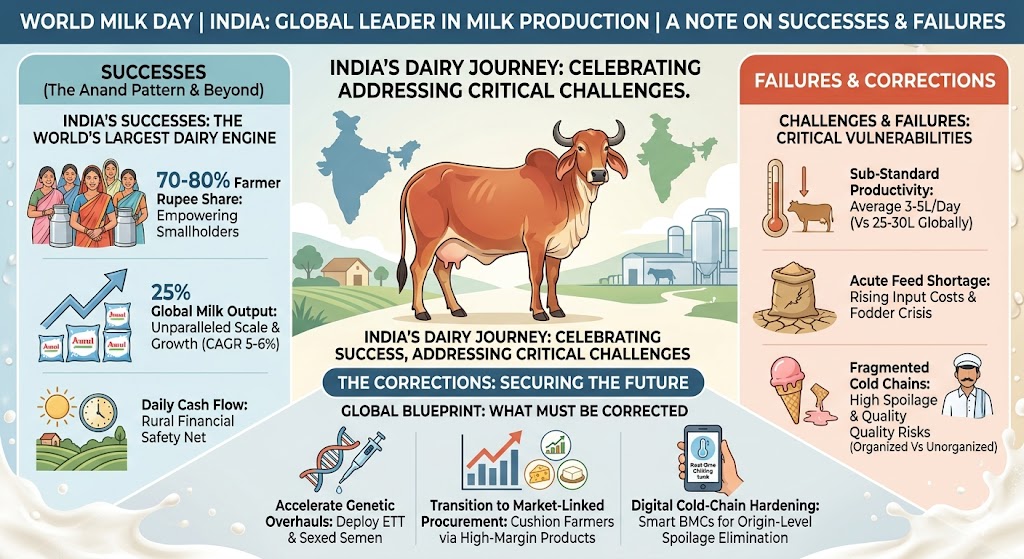
Today, on World Milk Day (June 1, 2026), India celebrates its status as the undisputed global leader in milk production. Contributing nearly 25% of the world’s total milk output, India’s dairy sector is a massive socio-economic engine that sustains over 80 million rural households. But India can do more, much much more and transition from largest milk producer to largest and most EFFICIENT milk producer. Read on…
As India’s Dairy the industry looks toward the next decade, this massive scale achieved so far is being tested by structural inefficiencies. Here is our evaluation of India’s dairy successes, failures, and the critical course corrections required to cement its future leadership.
Successes: Building the World’s Largest Dairy Engine
1. Cooperative Model (Anand / AMUL Pattern)
India’s greatest dairy achievement is the democratization of the supply chain through the three-tier cooperative structure (Village Society / District Union / State Federation), originally pioneered by AMUL and supported by National Dairy Development Board (NDDB). By eliminating predatory middlemen, this model ensures that 70–75% of the consumer rupee is passed directly back to the smallholder farmer—one of the highest efficiency margins in the world
2. Unparalleled Scale and Growth Rate
While global dairy growth crawls at 1–2% annually, India’s milk production has maintained a robust compound annual growth rate (CAGR) of 5–6%. Output has surged to over 230 million metric tonnes, ensuring complete self-sufficiency and robust food security for a population of 1.4 billion
3. Year-Round Rural Liquidity
Unlike seasonal crop agriculture, which relies heavily on monsoon cycles, dairy provides daily or weekly cash flows to rural families. It acts as a critical economic safety net, particularly for landless and marginal farmers, and has driven significant women’s empowerment, as women constitute over 70% of the active dairy workforce
And The Failures: Fragility Behind the Numbers
1. Chronically Low Animal Productivity
India’s massive milk production volume is driven by the sheer large number of its livestock population rather than high milk yields per animal as in many countries of the world.
-
An average Indian cow produces roughly 3–5 liters of milk per day, compared to 25–30 liters in the US, Israel, or New Zealand
-
This makes the Indian model highly resource-intensive and environmentally taxing per kilogram of milk produced compared to other countries
2. Upstream Feed and Nutrition Crisis
The biggest structural bottleneck is an acute shortage of quality animal feed and green fodder. As highlighted by the recent 17% collapse in domestic soybean yields, the cost of compound cattle feed has skyrocketed. Farmers are forced to rely on crop residues or sub-standard forage, which severely stunts the genetic yield potential of the cattle
3. Fragmented Cold Chains & Quality Sub-Standardization
While massive progress has been made by major co-operatives, a staggering 60–70% of milk in India still flows through the unorganized sector (local milkmen and uncertified vendors). The lack of village-level Bulk Milk Coolers (BMCs) means milk often travels for hours in intense tropical heat before pasteurization, leading to higher bacterial counts and limiting India’s ability to export to strict markets like the EU or US
Global Blueprint: What Must Be Corrected?
To transition from a model of mass production to one of production by the masses with global yeild efficiency, India must execute three immediate policy and technological shifts:
1. Accelerate Genetic Overhauls via ETT and Sexed Semen
India cannot afford to keep expanding its cattle population due to land and water constraints. The focus must shift entirely to herd optimization by focussing on better yeilds per dairy animal.
-
Sexed Semen Technology: Government programs must subsidize sexed semen to ensure over 90% of births are high-yielding female calves, eliminating the economic burden of unwanted male calves
-
Embryo Transfer Technology (ETT): Accelerate the deployment of ETT to implant embryos of elite indigenous breeds (like Gir, Sahiwal, and Tharparkar) into low-yielding surrogate cattle, rapidly upgrading the national genetic baseline

