


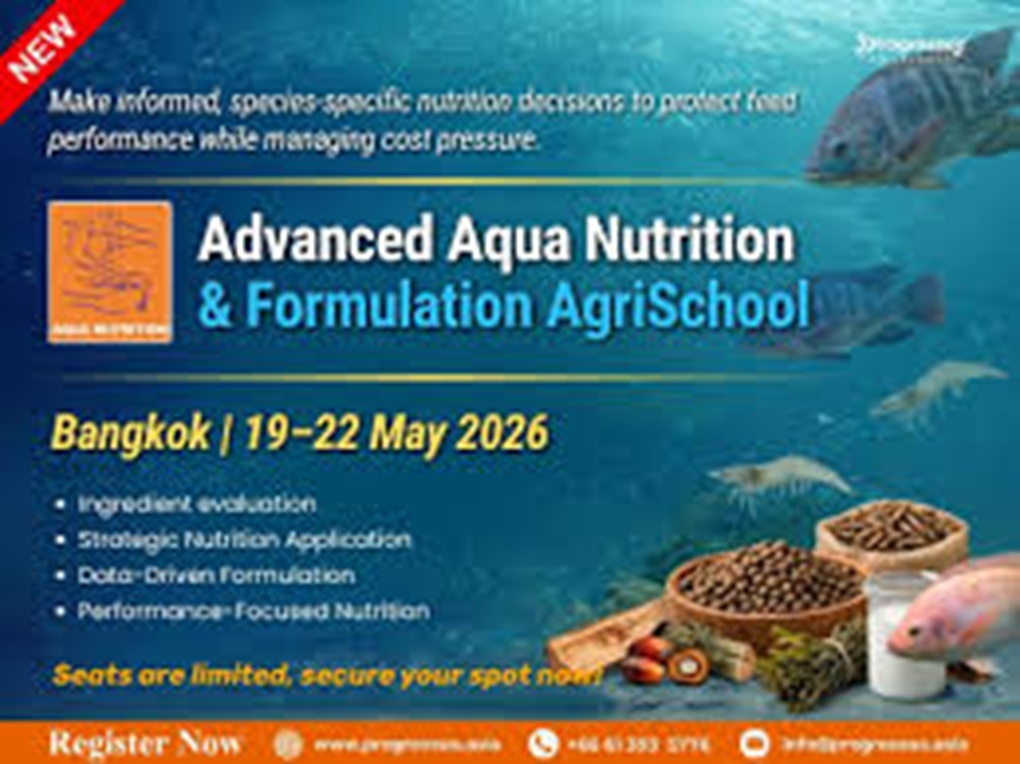
The Advanced Aqua Nutrition & Feed Formulation AgriSchool 2026 entered its highly anticipated second day at the Mövenpick Hotel Sukhumvit 15. Running from May 19–22, 2026, this intensive four-day elite training assembly, organized by Progressus, has brought together top-tier commercial feed formulators, aquaculture nutritionists, and technical directors from across the Asia-Pacific region.
The core mission of the 2026 curriculum addresses a profound structural shift: Asia’s multi-billion-dollar aquaculture sector has entered an era of unprecedented input complexity. With traditional marine raw materials like fishmeal and fish oil becoming highly volatile and unpredictable due to climate anomalies and tightening catch quotas, commercial mills can no longer rely on rigid legacy recipes. Concurrently, intensifying global sustainability benchmarks are forcing mills to rapidly adopt data-informed, low-carbon footprints without sacrificing animal performance.
Core Scientific Mandate: Moving Beyond “Reactive Reformulation”
A central theme echoing through the technical sessions is the dangerous financial reality of arbitrary cost-cutting. Program facilitators warned that while many feed manufacturers are aggressively altering recipes to control raw material overheads, doing so without a species-specific understanding of nutrient kinetics can cause unintended performance drop-offs, elevated Feed Conversion Ratios (FCRs), and compromised farm-level uniformity.
The 2026 AgriSchool shifts the conversation from merely cutting upfront raw material costs to maximizing total feed value. This requires commercial formulators to fully master how fish and crustaceans physically process alternative protein and lipid structures under shifting farm environments.
Elite Facilitator Insights & Session Breakdown
The program combines top academic research with practical, real-world feed mill experience, led by an elite panel of international experts:
Dr. Thomas Wilson (Lead Facilitator & Aqua Nutrition Consultant)
A pioneer in warm-water aquatic nutrition, Dr. Wilson focused his Day 2 lectures on mastering amino acid kinetics and maximizing complex carbohydrates. He noted that as plant-based proteins replace marine proteins, feed lines must adapt to high loads of Non-Starch Polysaccharides (NSPs).
Dr. Wilson detailed how matching specific exogenous enzyme matrices—such as xylanases, glucanases, and protease complexes—unlocks energy trapped behind plant cell walls, allowing omnivorous species like Tilapia and various carps to thrive on low-fishmeal options.
Dr. Noratat Prachom (Kasetsart University / AIT)
Leveraging over 15 years of R&D and QA experience, Dr. Prachom detailed the practical realities of high-density shrimp nutrition. His sessions mapped out the sensitive digestive plumbing of Penaeus vannamei across different life stages, exploring how functional additives, organic acids, and optimized trace mineral pathways can protect gut health and maintain robust immune function during environmental stress.
Dr. Daranee Seguin (Aqua Nutrition Expert & Content Architect)
Dr. Seguin led sessions breaking down laboratory data interpretation, showing participants how to read raw ingredient specs with higher precision. Her presentations demonstrated how to properly assess alternative raw materials—like insect meals, single-cell proteins, and localized agricultural byproducts—ensuring that laboratory values perfectly align with real-world biological digestibility.
Ian Mealey (Product Marketing Director for Formulation, Datacor)
Representing the software engine behind modern feed plants, Ian Mealey led the formulation workshop tracks utilizing advanced Datacor (formerly Format Solutions) architectures. Mealey’s sessions walked formulators through advanced linear programming, demonstrating how to use software constraints to navigate raw material shortages, leverage shadow pricing, and execute precise ingredient substitutions while strictly maintaining physical pellet integrity and water stability.
Timeline: The 4-Day Applied Curriculum
The program is structured to systematically turn scientific principles into immediate, plant-level execution:
-
Day 1: Quality Control & Ingredient Metrics: Focused on raw material intake, evaluating alternative protein and lipid alternatives, and building strict quality control standards to accurately flag incoming ingredient variation
-
Day 2: Advanced Nutrition & Feeding Kinetics: (Active Session) Diving into precise amino acid balancing, anti-nutritional factor containment, essential fatty acid pathways, and targeted shrimp formulation strategies across varying salinity profiles
-
Day 3: Feed Formulation & Computational Workshops: Hand-on interactive modeling using Datacor/Format software platforms. Participants work through live cost-performance optimization scenarios, setting real-world nutritional constraints for finfish and crustaceans
-
Day 4: Immunomodulation, Trials, & Sustainability Strategy: Connecting formulation decisions to farm performance. Topics cover how nutrition shields animals from disease stress, building scientifically sound on-farm feeding trials, and hitting corporate sustainability benchmarks
AHI Opinion
As Asia’s aquaculture sector intensifies, the Progressus Advanced Aqua Nutrition AgriSchool 2026 provides a timely antidote to reactive, margin-driven formulation mistakes. By showing nutritionists how to combine precise raw material science with advanced linear programming, facilitators like Wilson, Prachom, Seguin, and Mealey are helping mills protect their profits, stay resilient against market swings, and transition toward a sustainable, high-performance future.