



Efficacy and safety are top preferences when selecting antipruritic treatments, but dog owners and veterinarians want options that are easier to administer, more affordable and improve compliance.
Merck Animal Health, known as MSD Animal Health outside of the United States and Canada, a division of Merck & Co., Inc., Rahway, N.J., USA (NYSE:MRK), today announced results from a new global survey of dog owners and veterinarians revealing challenges and pain points associated with diagnosing the underlying cause of allergic skin disease in dogs and its treatment. According to Pet Owner and Vet Perspectives on Canine Pruritus: A Global Survey, about one-third of canine patients seen by U.S. veterinarians have itchy skin or allergic skin disease (27% of global canine patients) and about two in five dogs with skin conditions are newly diagnosed (U.S. and global).
Both dog owners and veterinarians feel fatigued and burdened by canine allergic skin disease, with 34% of U.S. dog owners reporting a notable negative impact on their own quality of life (31% globally). Additionally, 43% of dog owners who have dogs with itchy skin in the U.S. (39% globally) indicated a significant negative impact on the dog’s quality of life. In fact, 86% of U.S. dog owners (90% globally) who have taken their dog with scratchy/itchy skin to the vet have discussed their dog’s itch with their vet with 61% of those dog owners specifically making the appointments with their veterinarian to discuss their pet’s itchy skin (60% globally). The survey also revealed that both dog owners and veterinarians have difficulty finding an effective treatment, with 28% of U.S. dog owners and 36% of U.S. veterinarians having switched therapies used to treat allergic skin disease in the last year (compared to globally 29% and 41%, respectively).
To access vet and pet owner resources, click here.
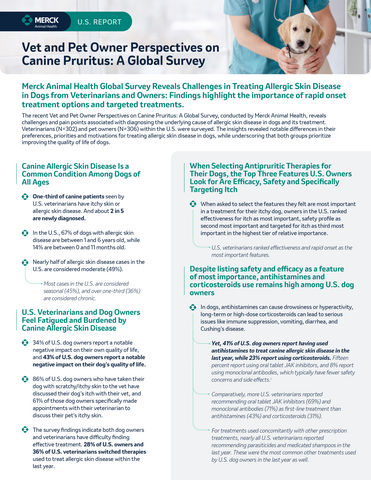
“Allergic skin disease is one of the most common clinical signs among dogs of all ages. Knowing that many dog owners and veterinarians are managing dogs with allergic skin disease, we wanted to understand the challenges they are facing when it comes to diagnosis, treatment, and compliance,” said Linda Horspool, BVMS, PhD, DipECVPT, FRCVS, Director Scientific Marketing Affairs, Global Marketing Companion Animals, Merck Animal Health. “We found that while veterinarians and owners both experience frustrations when communicating with one another about diagnosing the underlying cause of allergic skin disease and treatment plans, both parties have the same goal of finding a solution that is effective, safe and starts working fast.”
The insights from 1,710 dog owners and 1,413 veterinarians across 11 countries (8 countries for dog owners) revealed notable differences in their preferences, priorities and motivations for treating allergic skin disease in dogs. The findings underscore that dog owners and veterinarians both prioritize improving the quality of life of patients, but there are gaps in communication about the underlying cause of allergic skin disease, what to expect, the treatment selected, and how compliance impacts efficacy.
Key Findings
- When selecting antipruritic therapies for their dogs, the top three features U.S. owners look for are efficacy, safety and specifically targeting itch.
When asked to select the features they felt are most important in a treatment for their itchy dog, owners in the U.S. and globally ranked effectiveness for itch as most important, safety profile as second most important and targeted for itch as third most important in the highest tier of importance. Globally and in the U.S. veterinarians ranked effectiveness and rapid onset as the most important features. - Despite listing safety and efficacy as a feature of most importance, antihistamines and corticosteroids use remains high
In dogs, antihistamines can cause drowsiness or hyperactivity, long-term or high-dose corticosteroids can lead to serious issues like immune suppression, vomiting, diarrhea, and Cushing’s disease. Yet, 41% of U.S. dog owners report having used antihistamines to treat canine allergic skin disease in the last year (27% globally), while 23% report using corticosteroids (19% globally). Fifteen percent report using JAK inhibitors (11% globally), and 8% report using monoclonal antibodies (11% globally), which typically have fewer safety concerns and side effects.i
- Veterinarians and dog owners in the U.S. stopped using antipruritic treatment for the same top reasons – lack of efficacy and safety concerns.
For U.S. dog owners, the top reasons they discontinued use of antipruritic treatment were because the product was not as effective as they’d like it to be (32%), the product was too costly/expensive (28%), they had safety concerns (21%), and one dose did not last long enough (21%). For U.S. veterinarians, 44% cited poor efficacy, 38% cited less targeted treatment, and 28% cited poor safety profile. While U.S. dog owners and veterinarians were aligned, global dog owners differed with top reasons being poor efficacy (22%), slow to start (20%), and my dog did not enjoy receiving it (18%). Globally, veterinarians also most frequently cited poor efficacy (46%), less targeted treatment (31%), and poor safety profile (27%). - Both veterinarians and dog owners were motivated to start using a treatment that was easier to administer and improved compliance.
U.S. dog owners who started a new treatment cited top factors for starting the treatment as recommended by veterinary staff (40%), safer for my dog (38%), and easier to administer or apply to my dog (35%). Reasons why U.S. veterinarians started recommending a treatment were: better efficacy (46%), innovative treatment that adds to the toolbox (44%), better client compliance (28%), more targeted treatment (26%) and price (26%). Globally, dog owners cited recommended by my vet (32%), easier to administer or apply to my dog (32%), and safer for my dog (31%). Globally, veterinarians cited better efficacy (48%), innovative treatment that adds to the toolbox (36%), more targeted treatment (32%),faster onset of action (27%) and better client compliance (26%). - Some available treatments come with a cost burden. When asked about unmet needs in current antipruritic treatments, the majority of veterinarians said there was a gap in cost effective, more affordable options.
52% of U.S. veterinarians and 46% of veterinarians globally said the top unmet need for canine antipruritic treatment is more cost-effective options. Additionally, about 1 in 10 veterinarians globally (6% of U.S. veterinarians) said medication for dogs 6 months of age or older was an unmet need. 13% of dogs with allergic skin conditions seen by veterinarians worldwide were 6–11 months old (9% in the US) and therefore too young to receive a JAK inhibitor that is approved for dogs 12 months and older. - Additional global qualitative findings suggest that both dog owners and veterinarians desire better communication and understanding of treatment plans and disease progression/ what to expect.
Interviews with 60 veterinarians and 25 dog owners from across five countries including the U.S. revealed key themes around the allergic skin disease journey. The chronic nature and variability of the condition make it difficult to manage from patient to patient, leading to veterinarian fatigue. Veterinarians also reported that pet owners have a misunderstanding of the chronic nature of allergic skin disease and how treatments work, causing compliance to suffer. Meanwhile, pet owners shared that they try to create a routine, but some are forced to spread out doses to counteract costs. Many owners also reported not receiving enough information or instruction from their veterinarian.

