


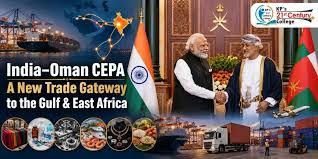
NEW DELHI / MUSCAT — In a historic development for South Asian agricultural and marine trade, the India-Oman Comprehensive Economic Partnership Agreement (CEPA) officially entered into force. The landmark deal establishes a dynamic, duty-free economic corridor connecting Indian producers directly to the lucratively expanding Gulf Cooperation Council (GCC) market.
According to top industry stakeholders and export councils, the trade pact serves as an immediate catalyst for India’s agro-pastoral economies. By dismantling long-standing tariff barriers, it positions Indian poultry, livestock, and seafood as highly competitive alternatives to shipments from non-preferential trading nations.
Transformational Boost for Indian Agritech and Livestock
The trade pact provides sweeping, immediate market access across multiple labor-intensive agricultural lines. To protect vulnerable domestic sectors, both nations implemented careful exclusions—with India shielding sensitive spaces like domestic dairy, rubber, and oilseeds. However, the agreement goes all-in on commercial livestock, poultry, and fisheries.
“The India-Oman Free Trade Agreement is a significant boost for India’s agriculture, poultry, livestock, and marine export sectors,” stated Divya Kumar Gulati, Chairman of the Compound Livestock Feed Manufacturers Association of India (CLFMA).“By providing duty-free access for key products such as shrimp, fish, eggs and other food items, the agreement will make Indian exports more competitive in a strategically important Gulf market,” Gulati emphasized.
The standard Most Favoured Nation (MFN) import duty, which sat at a flat 5% across most Omani tariff lines, has effectively dropped to 0% for verified Indian agricultural consignments. This immediate cost reduction directly offsets the domestic margin pressures Indian poultry integrators have faced due to extreme summer heatwaves and fluctuating feed grain prices.
Seafood Exports: Capturing the $25 Million Untapped Value Gap
For India’s highly organized marine processing sector, the removal of tariffs represents an unprecedented commercial opportunity. Indian aquaculture and wild-capture processors are globally recognized for strict traceability protocols, modern cold-chain infrastructure, and uncompromised compliance with rigorous international food safety standards.
The data underscores a severe trade imbalance that the CEPA is structurally designed to fix:
-
Oman’s Annual Marine Import Footprint: $35.3 million.
-
India’s Prior Market Share: Roughly $10 million.
-
The Untapped Opportunity: A massive $25.3 million structural void ripe for penetration by Indian seafood exporters.
“The grant of duty-free access to marine products provides Indian seafood exporters with a stronger platform to expand their presence in Oman and use it as a gateway to the wider Gulf region,” Gulati observed. This export boom is expected to drive immediate financial liquidity down to aquaculture farmers, local hatcheries, and coastal processing economies spanning Andhra Pradesh, Kerala, Tamil Nadu, and Gujarat.
Marine Products: Marine Products: Enhancing India’s Presence in Regional Seafood Value Chains
-
All marine products including shrimp, fish and cuttlefish receive immediate duty-free access replacing earlier import duties of up to 5%.
-
Oman’s marine imports stood at USD 35.3 million in 2025 while India’s exports accounted for only USD 10 million, indicating substantial untapped potential.
-
The Agreement is expected to significantly expand exports from major coastal states including Andhra Pradesh, Kerala, Tamil Nadu and Gujarat.
-
Indian marine exporters gain improved competitiveness, faster clearances and stronger integration into Gulf-region food supply chains.
Strengthening the Egg Supply Chain to the Gulf
Oman has long stood as an essential destination for Indian poultry products, operating as a primary destination for table eggs, pasteurized liquid egg yolk, and processed egg powders. Under the newly active CEPA framework, Indian egg exports are poised to secure a dominant market share in Omani supermarkets and institutional food service channels.
To ensure seamless execution and eliminate operational bottlenecks, the agreement introduces groundbreaking trade facilitation measures. Chief among these is the automated port-level acceptance of Export Inspection Council (EIC) Certificates from India. Backstopped by a fully digitized Certificate of Origin (CoO) electronic exchange framework, the system eliminates multi-day customs holds at Omani ports like Sohar, Duqm, and Salalah.

