


HomeCorporateHarmonizing Pharma Standards: EMA Human and Veterinary Synthetic Peptide Guidelines Take Effect

Harmonizing Pharma Standards: EMA Human and Veterinary Synthetic Peptide Guidelines Take Effect

A major, long-anticipated regulatory overhaul has officially reshaped the compliance landscape for the European pharmaceutical and animal health sectors. EMA has removed the costly trial-and-error approach that previously slowed down veterinary peptide approvals which adversely affected the approval timelines.
Effective June 1, 2026, the European Medicines Agency’s (EMA) “Guideline on the Development and Manufacture of Synthetic Peptides” (EMA/CHMP/CVMP/QWP/367182/2025) has entered into full legal force across all European Union member states.
Adopted via a joint cross-disciplinary alliance between the CHMP (Committee for Medicinal Products for Human Use) and the CVMP (Committee for Veterinary Medicinal Products), the document establishes a unified, product-specific quality architecture spanning the entire lifecycle of synthetic peptide active substances.
By standardizing manufacturing controls, purification metrics, and impurity profiling, the EMA has closed a critical regulatory gap that previously forced peptide developers to navigate fragmented, non-specific chemical synthesis directives.

Closing the Regulatory Gap for Advanced Therapeutics

Peptide-based therapeutics—compounds generally consisting of amino acid chains linked by peptide bonds—have witnessed an unprecedented surge in clinical deployment. In veterinary medicine, synthetic peptides are driving next-generation innovations, including targeted immunotherapies, specialized metabolic modulators, and precise antimicrobial alternatives designed to bypass traditional antibiotic resistance channels.
Historically, because peptides sit at the structural intersection of small-molecule chemicals and complex biological proteins, regulatory submissions faced inconsistent review parameters. The new guideline replaces this ambiguity with concrete, mandatory quality expectations.
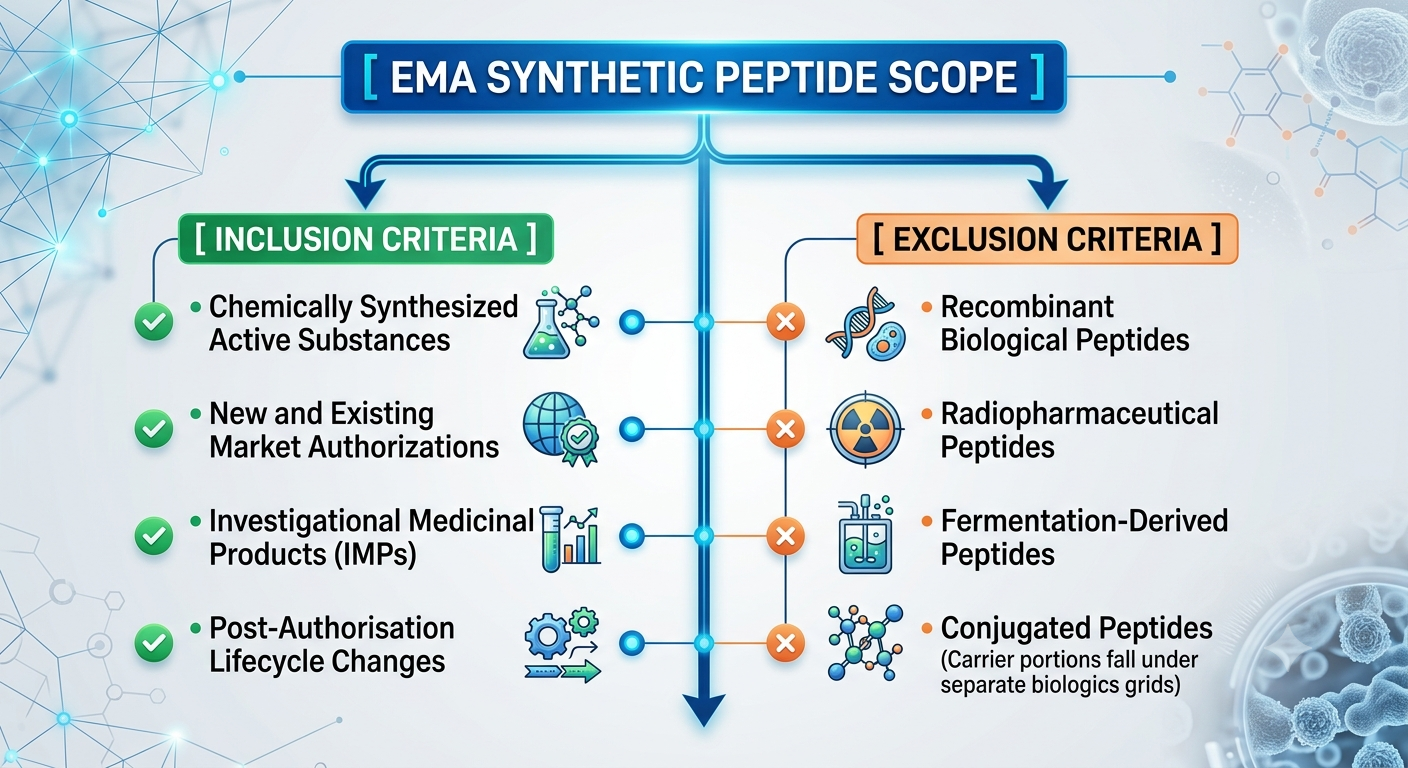
The mandate explicitly covers all new marketing authorization applications, existing substance updates, post-authorisation variations, and Investigational Medicinal Products (IMPs) utilized in clinical and veterinary field trials.
Critical Manufacturing and Impurity Profiling Directives

The core of the joint CHMP/CVMP guideline dictates rigorous analytical precision during the manufacturing process, focusing heavily on Solid-Phase Peptide Synthesis (SPPS) and Liquid-Phase Peptide Synthesis (LPPS) methodologies:
1. Starting Material Specifications
Manufacturers must now provide exhaustive characterization and stereochemical purity profiles for all protected amino acid building blocks, resin linkers, and coupling reagents. The EMA mandates that the risk of racemization (the accidental conversion of optically active compounds into asymmetric mixtures) be strictly quantified at each synthesis stage.
2. Analytical Control of Impurities
Due to the stepwise nature of peptide chain elongation, synthetic batches are prone to “deletion sequences” (missing amino acids) and truncation impurities. The guideline enforces highly sensitive high-performance liquid chromatography (HPLC) or mass spectrometry (MS) boundaries to isolate, identify, and qualify structurally related impurities.
3. Structural Justification for Veterinary Medicine
For veterinary drug formulations, developers must provide clear proof of the synthetic peptide’s higher-order structure (secondary and tertiary folding) if the therapeutic mechanism relies on specific spatial configurations. This is critical for demonstrating consistent batch-to-batch bioactivity and safety.

Clear Exclusions: Defining the Biological Boundary

To prevent regulatory overlap, the joint working group established strict boundary lines. The guideline explicitly excludes biological peptides produced via recombinant DNA technology or cell-culture fermentation, as well as peptide-based radiopharmaceuticals. These categories will continue to be governed exclusively under separate, pre-existing European biotechnological and advanced biological frameworks.
Furthermore, for synthetic peptides conjugated to other moieties (such as pegylated peptides or peptide-drug conjugates), the guideline applies strictly to the development, synthesis, and control of the raw peptide core, while the finished conjugate remains bound to broader biological product directives.

Strategic Impact on Next-Gen Veterinary Biologics

The enforcement of this guideline introduces immediate operational implications for animal health R&D pipelines targeting the lucrative EU market. While the rule increases the upfront analytical burden and testing documentation required for dossier submissions, it delivers long-term regulatory predictability.
By clarifying the exact milestones needed for validation, the EMA has removed the costly trial-and-error approach that previously slowed down veterinary peptide approvals. Animal health integrators, contract development and manufacturing organizations (CDMOs), and biopharmaceutical firms must immediately audit their active ingredient files (ASMFs) and synthesis protocols to ensure full alignment with these newly active European standards.
RELATED ARTICLES

LEAVE A REPLY

Please enter your comment!
Please enter your name here