Product Pipeline of Boehringer Ingelheim Animal Health
DERIO, Spain — Leading global veterinary virologists, molecular biologists, and poultry health stakeholders converged at Spain’s prestigious CIC bioGUNE research facility for an international summit held under the banner of the European Union’s SPIDVAC project (Sustainable Pig and Poultry Disease Vaccine Solutions).
The primary objective of the high-level technical convention was to deliver a coordinated scientific response to the persistent, multi-continental crisis of Highly Pathogenic Avian Influenza (HPAI), which continues to threaten global food grids, decimate commercial flocks, and present a persistent zoonotic mutation risk.
Overcoming “Maternal Immunity” Bottleneck
The centerpiece of the summit was an advanced research showcase presented by the avian R&D division of Boehringer Ingelheim Animal Health. The company’s virologists detailed the successful development of next-generation vaccine candidate matrices engineered specifically to resolve the single greatest bottleneck in juvenile poultry immunization: Maternal Antibody Interference (MAI).
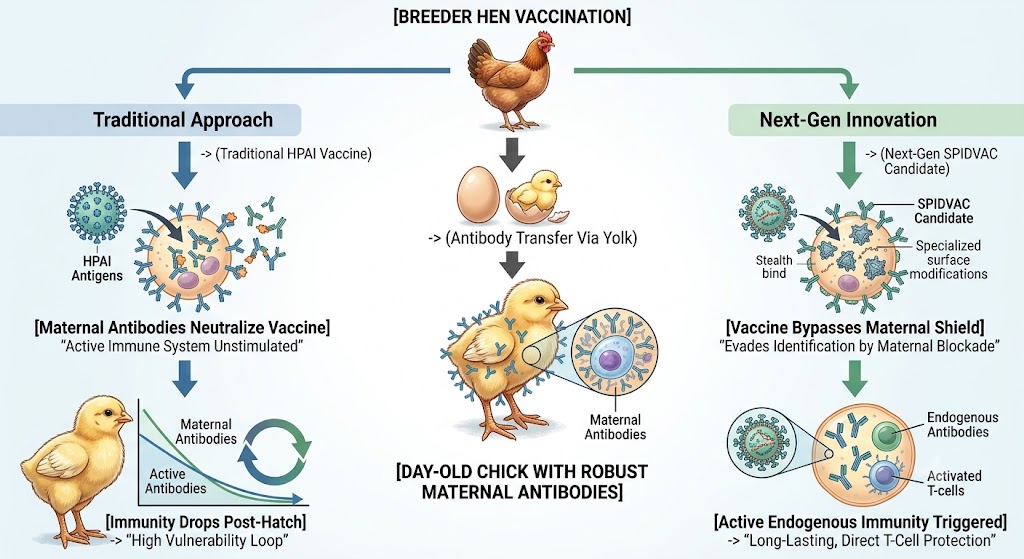
[Image diagram showing the mechanism of maternal antibody interference in young chicks where existing maternal antibodies bind to traditional vaccines, blocking the chick’s immune system from building its own active antibodies]
Historically, vaccinating young day-old chicks against HPAI has been highly inefficient. While breeder hens transmit robust protective antibodies to their offspring via the egg yolk, these circulating maternal antibodies act as a biological shield that inadvertently neutralizes standard vaccines. This premature neutralization prevents the chick’s naive immune system from recognizing the vaccine’s antigen and building its own active, long-lasting immunity—leaving millions of birds highly vulnerable to infection precisely as their maternal antibody levels naturally decline a few weeks post-hatch.
Precision Antigen Engineering
Boehringer Ingelheim’s newly engineered vaccine candidates bypass this interference by utilizing advanced viral vector platforms and tailored surface proteins.
By altering the specific epitope configurations of the vaccine’s antigen, researchers have designed a formula that remains entirely “invisible” to the circulating maternal antibodies. This allows the vaccine vector to slip past the initial maternal immune blockade undetected.
Once inside the target host cells, the vaccine safely triggers endogenous antigen expression, stimulating the chick’s own B-cells and T-cells to mount a permanent, active immune memory.
Strategic Value: Hardening Flocks Against Wild Flyway Cross-Overs
The clinical data presented at CIC bioGUNE confirmed that these next-generation matrices deliver a significantly prolonged duration of immunity (DOI) compared to legacy commercial formulas. A single, automated in-ovo (in-egg) or day-of-hatch administration provides uniform protective coverage extending across the entire commercial lifespan of broilers and layers.
This long-lasting durability is critical for the European agricultural sector, which faces intense pressure from mutating HPAI strains carried along wild migratory bird flyways. Because wild waterfowl regularly drop viral loads near intensive poultry hubs, establishing an unbreachable, lifelong immune barrier in commercial flocks is the only viable alternative to devastating, multi-million-bird culling mandates.
The SPIDVAC consortium confirmed that these validated candidates will now move into accelerated field validation protocols, paving the way for synchronized regulatory submissions under the European Medicines Agency (EMA) framework.