


A trinity of challenges in form of higher input costs, mortalities due to heatwaves and random HPAI outbreaks and lower farmgate prices, all at same time, are testing resilience of India’s poultry and aquaculture industry. Poultry Federation of India, a key organization representing interests of all poultry farmers, small and corprates, is exhorting Government for an immediate steps to ease pain of poultry farmers.
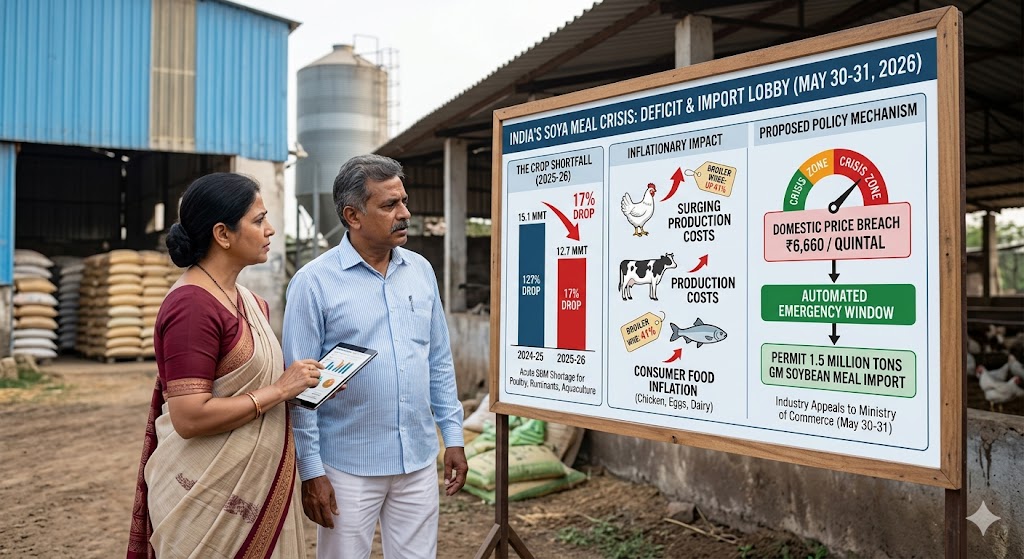
The domestic livestock, poultry, and aquaculture supply chains in India are facing higher production costs due to a severe raw material supply scarce and consequent increase in raw material prices. Government data released via the Press Information Bureau (PIB) confirms that India’s 2025–26 soybean production dropped by approximately 17% to 18%, bottoming out between 12.60 MMT and 12.72 MMT}, down from the previous cycle’s $15.1 MMT to 15.27 MMT.
This shortfall has triggered an acute supply shortages of domestically produced Soybean Meal (SBM), the key input input for animal feed. SBM supply constraints have rresulted in higher prices and increased costs of animal feeds. Local price rise in SBM prices forced, Indian exporters to mutually terminate and cancel over 25,000 metric tons of forward SBM export contracts for May and June delivery because they could not absorb a sudden $200 per ton price surge locally without renegotiations. Domestic soya meal prices shot up 41% in a single month, breaching ₹66,000 per metric ton—a four-year high—which effectively priced Indian non-GMO meal out of the international market ($695/MT FOB vs. $475/MT previously).
Impact: Margin Compression & Food Inflation
Because feed components constitute 65% to 70% of total production overheads in commercial poultry farming, the compound feed industry can no longer absorb these soaring input costs.
-
Poultry & Dairy: Small and medium-sized livestock operations are reporting immediate margin compression. This is translating into wholesale price hikes for live broilers, commercial table eggs, and processed dairy products. The crisis is worsened by parallel price hikes in other, potential replacement raw materials such as feed-grade corn and de-oiled rice bran
-
Aquaculture: The shrimp and inland fish feed industries are facing severe cost pressures, threatening India’s seafood export margins just as regional processing networks attempt to scale up
To survive, some crushers have resorted to importing expensive non-GMO raw soybeans from African nations (Benin, Togo, and Niger) at steep premiums ($700 to $760/MT CIF) under Least Developed Country (LDC) duty provisions. However, these volumes remain entirely inadequate to cover the massive domestic deficit.
Policy Battle: Request for Automated GM Soyameal Imports
During the May 30–31 weekend, a coalition of prominent poultry federations, animal nutrition associations, and aquaculture bodies intensified their coordinated lobbying efforts directed at the Ministry of Commerce and the Ministry of Animal Husbandry.
The center of this policy push is a demand for a tariff-rate quota (TRQ) allowing the immediate import of 1.5 million tons of Genetically Modified (GM) soybean meal to tide over current crisis. Industry bodies argue this temporary window is vital to balance the domestic market during the critical five-month gap remaining before the next Kharif harvest arrives in October.
Industry’s Core Arguments:
-
Consumer Price Moderation: The landing price of imported GM meal post-duty is projected at roughly ₹62,500 per ton, which would immediately cool down domestic meal prices and curb retail food inflation
-
Fiscal Revenue Generation: Opening this specific 1.5 MMT import window would generate an estimated ₹450 crores in import duty revenue for the government
-
Grower Safeguards: Because the automated trigger only activates when raw bean prices breach ₹6,660 per quintal, domestic farmers are still guaranteed a 25% to 30% premium over the government-mandated Minimum Support Price (MSP), ensuring their profitability is not harmed

