



BRUSSELS / CANBERRA — The European Commission and the Australian Government have officially concluded high-level treaty negotiations, formalizing Australia’s association with Horizon Europe—the EU’s premier €93.5 billion (approximately AUD 155 billion) research and innovation funding framework.
Announced on Tuesday by European Commissioner for Startups, Research, and Innovation Ekaterina Zaharieva and Australian Minister for Industry and Science Ed Husic, the historic agreement marks a major pivot toward globalized, science-led agricultural and climate solutions.
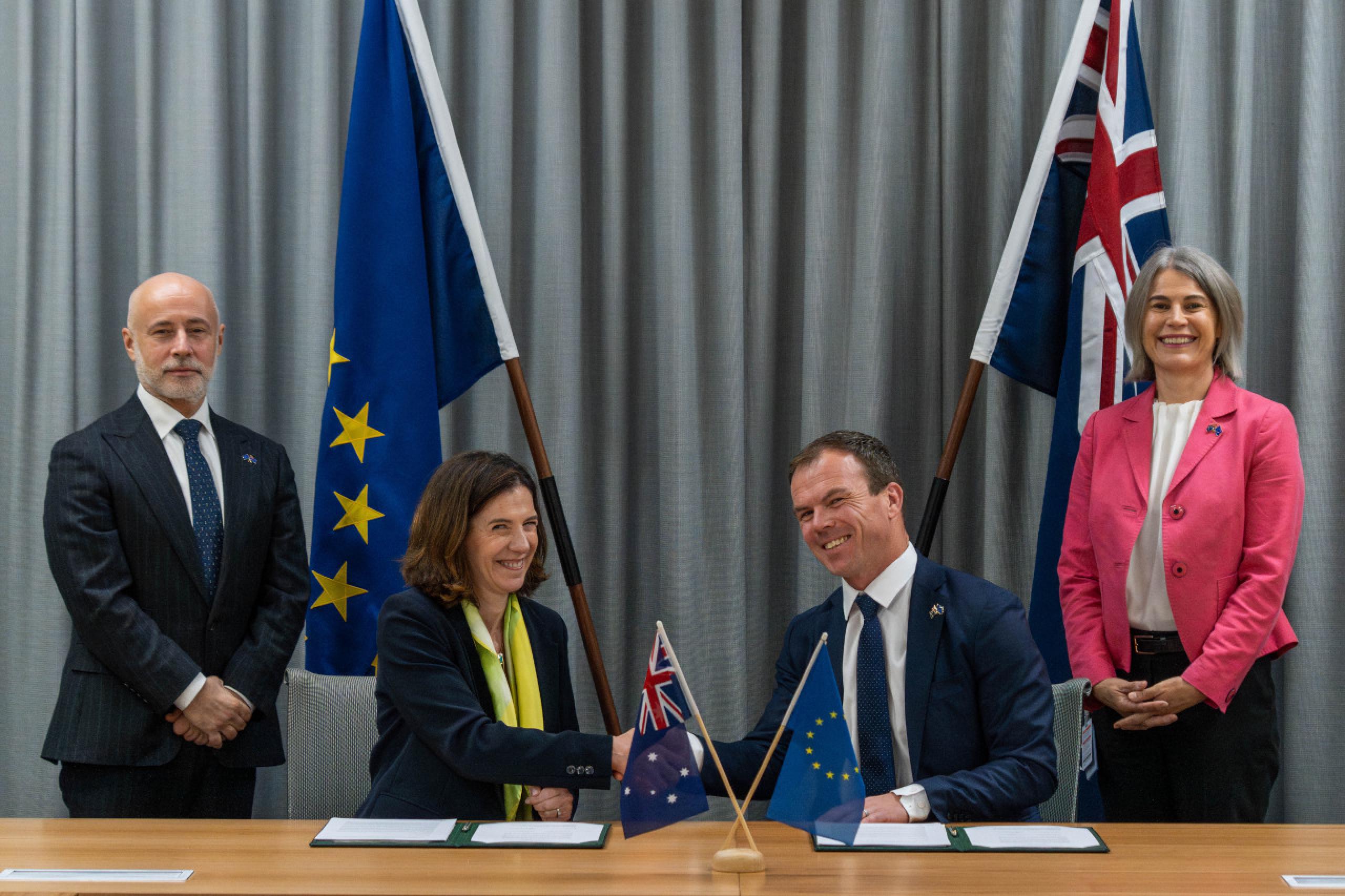
Under the newly finalized terms, Australia will formally associate with Pillar II of the program starting in January 2027. This specific pillar addresses global societal challenges, allowing Australian entities to transition from rigid “third-country” self-funding restrictions to being recognized as fully eligible entities. For the first time, Australian universities, agricultural corporations, and research bodies will have routine access to pool EU funding and lead multinational project consortia on equal terms with EU Member States.
Deepening the Livestock Connection
While the broader treaty encompasses critical technologies, digital space, and energy security, a substantial portion of the collaborative momentum is target-locked on food, bioeconomy, and agriculture.
Both the EU and Australia operate massive livestock sectors that face an identical dual-pressure: maintaining production efficiency and food security while rapidly cutting down greenhouse gas (GHG) footprints to meet mid-century climate goals. Prior to this treaty, joint research between the two continents was highly fragmented. The new Horizon Europe alignment creates a frictionless pipeline for shared funding, raw agricultural data, and cross-border field trials.
According to joint statements released by the European Commission and the Group of Eight (Go8) universities in Australia, three core pillars of agricultural technology will dominate early funding rounds:
1. Advanced Enteric Methane Reduction
With livestock accounting for a significant share of global agricultural emissions, scientists from both hemispheres will pool resources to accelerate the development of enteric methane inhibitors. Research will center on:
-
Perfecting the commercial scalability of bioactive feed additives (such as Asparagopsis seaweed and synthetic chemical inhibitors).
-
Investigating baseline genetic selectors to breed cattle and sheep with naturally lower methane profiles without degrading meat or milk yields.
2. Climate-Resilient Animal Feed Formulations
As shifting weather patterns, prolonged droughts, and erratic monsoons threaten pasture stability in both the Australian Outback and the European Mediterranean, funding will flow directly into alternative crop science. Research groups will co-develop circular feed solutions, drought-resistant forage crops, and protein-optimized, low-carbon rations designed to shield livestock producers from sudden global feed supply-chain shocks.
3. Precision Livestock Farming (PLF) Digital Infrastructure
To counter structural labor shortages and optimize animal welfare metrics, the alliance will heavily prioritize digital infrastructure. Projects will integrate AI-driven telemetry, automated livestock health monitoring systems, biometric ear tags, and precision automated feeding systems to maximize the feed conversion ratio (FCR) across commercial dairy, beef, swine, and poultry facilities.
Summary of the Bilateral Framework
Metric / Aspect |
Agreement Details |
Total Global Fund Size |
€93.5 Billion (AUD ~155 Billion) |
Primary Scope of Accord |
Full Association with Pillar II (Global Challenges) |
Operational Date |
January 2027 (Following domestic treaty ratifications) |
Agri-Tech Funding Focus |
Methane mitigation, resilient feed, and smart PLF infrastructure |
Current Performance |
Australian organizations have already yielded a 24.39% success rate across 239 preliminary Horizon projects |
From Access to Real-World Outcomes
The deal has been met with widespread acclaim across the global scientific community. Vicki Thomson, Chief Executive of Australia’s Group of Eight, termed the conclusion of the treaty a “once-in-a-generation opportunity” to turbocharge the impact of top-tier academic research.
“We can tackle the challenges of tomorrow only together,” noted Commissioner Ekaterina Zaharieva during the initialing ceremony in Brussels. “By combining our strengths in industry, climate action, and the bioeconomy, we will drive the next generation of transformative innovations.”

