

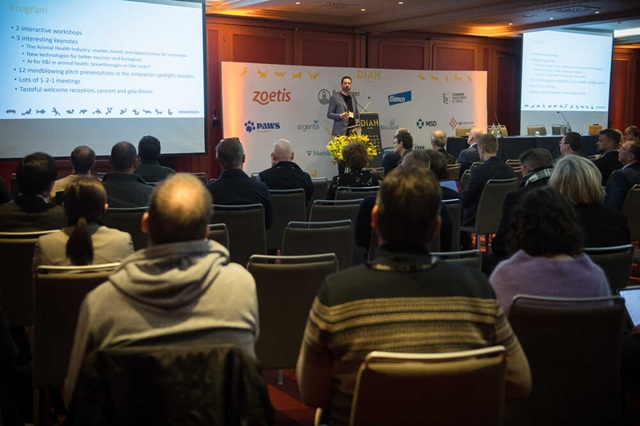
BRUGES, BELGIUM — The second biennial Discovery to Innovation in Animal Health (DIAH) Conference 2026 concluded its three-day run at the Bruges Meeting and Convention Center (BMCC). Sponsored by AnimalhealthEurope and organized by Provaxs (Ghent University), the highly specialized event brought together a select group of 200 delegates, establishing itself as the premier European destination for early-stage animal health research and development.
Unlike standard commercial B2B match-making expos, DIAH differentiators lie entirely in its focus on the pre-development, discovery, and proof-of-concept (PoC) phases. The conference acts as a bridge to fill a long-standing operational gap in Europe, connecting academic researchers, institutional spin-offs, and early-stage biotech startups directly with the scouting teams of Tier-1 animal health multinationals.
Structural Masterclasses: Accelerating the Path to Commercialization
A core strategic pillar of DIAH 2026 was a series of expert-led masterclasses designed to guide academic developers through the complex regulatory and scale-up pathways required to translate laboratory science into market-ready assets.
Unified Vaccine Platform (UVP) — Verovaccines GmbH
A standout session led by Ulrike Diesterbeck focused on the deployment of the Unified Vaccine Platform (UVP). Built around an advanced antigen capsule technology, this framework enables end-to-end process standardization—from antigen design through regulatory filing to industrial-scale manufacturing.
The platform has been validated across seven distinct vaccine programs targeting both enveloped and non-enveloped viruses. A key case study featured VeroBlue-3, a recombinant bluetongue virus serotype 3 vaccine that progressed from baseline concept to full European Medicines Agency (EMA) dossier completion within just nine months. This timeline highlights a significant acceleration over conventional inactivated virus methods, offering an agile alternative to mRNA-based pipelines.
Ruminant Vaccine Scaling — Moredun Research Institute
Dr. Stewart Burgess led a masterclass on the operational lifecycle of ruminant vaccine development. The framework provided a blueprint for navigating the technical friction points that often derail academic proof-of-concepts before they reach commercial manufacturing pipelines.
Innovation Spotlight: The Pitch Sessions
The core of the conference centered on the Innovation Spotlight, which featured two distinct pitch tracks: Emerging Technologies (earliest-stage scientific discovery) and Emerging Startups (entrepreneurial scientists preparing for spin-off launches). Pitched innovations spanned a broad multi-disciplinary matrix, including:
-
Therapeutics & Specialized Biologics: Targeted monoclonal antibody fragments and next-generation antimicrobials aimed at bypassing the European Union’s tight restrictions on sub-therapeutic veterinary drug use
-
Point-of-Care (PoC) Diagnostics: Low-cost, fast field-testing kits designed to allow farm veterinarians to track viral variants on-site, minimizing regional quarantine delays
-
Medical Devices & E-Health: Integrated hardware and cloud-based software tools using artificial intelligence to monitor biometric and behavioral indicators of animal pain and stress, directly supporting global farm welfare requirements